

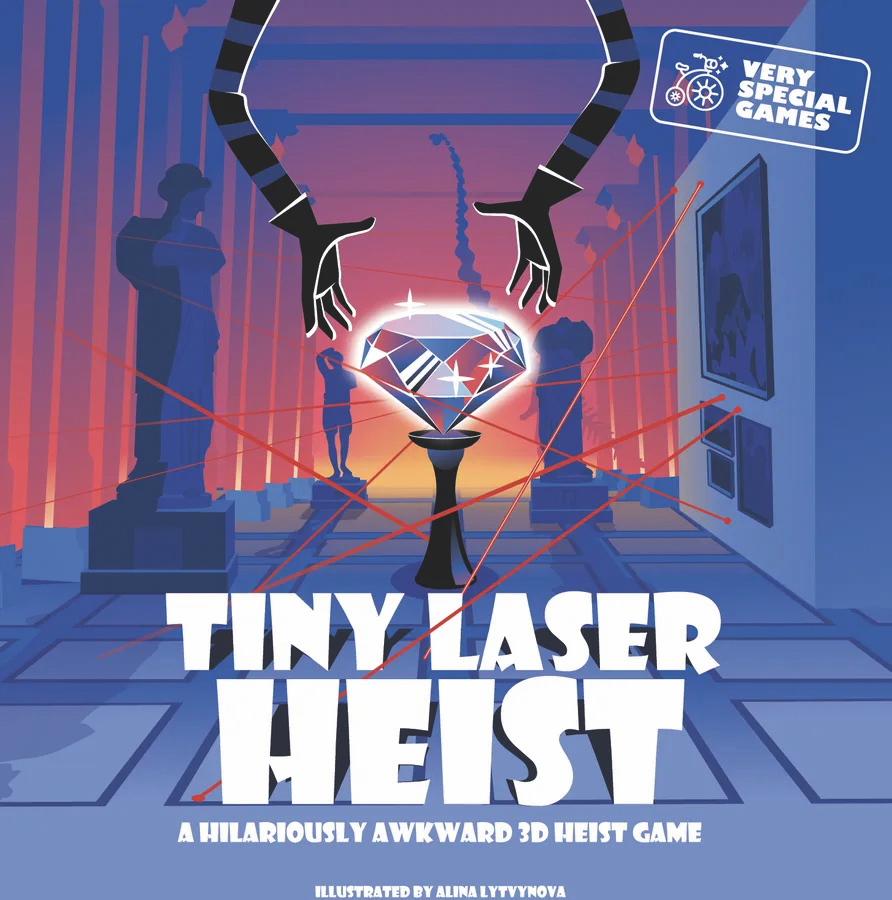
Tiny Laser Heist is a chaotic dexterity party game where players use rubber hands to steal diamonds under pressure. Equal parts hilarious and punishing, it’s a heist game like no other.
Written by Charlie Theel
Some games are just nonsense – in a good way. Tiny Laser Heist is such, pitting players in a semi-cooperative experience where they must use little rubber hands on the end of sticks to lift plastic diamonds from the board while avoiding laser tripwires. Oh, and this must be done in less than 90 seconds.
This is a game of laughter and hijinks. One player is assigned the role of Mastermind. They invite others at the table to join in the heist so they can assemble their team. To do so, everyone must agree to split a public pool of money cards between the participants, possibly engaging in a few minutes of negotiation to coax helpers along. The Mastermind has the say on who gets how many cards, although no one knows the value of the score as the cards are all divided up face-down.
Once things are settled, someone clicks “go” on the associated web application and all hell breaks loose. Klaxons start blaring from the app while the crack team of thieves springs to life. Each player must deftly manoeuvre their tiny hand implement between stretched trip wires, working with one or more other participants to lift the chunky diamonds from pedestals and deliver them to a centre space on the board. Since each player only has a single rubber hand, it’s fundamentally a requirement to work together. If the diamonds are successfully nabbed, then the agreed-upon loot division is rewarded and all players retire to their corners a little richer.
This heist phase occurs several times throughout the session, with the end game triggered by the deck of reward cards running dry. It’s a relatively simple affair with players hollering at each other and those on the sidelines hoping the gang goes bust. While this appears every bit the straightforward family game that is sure to appeal to youngsters, it’s important to recognise how incredibly vicious the experience can be.
Related article: Another Heist? Try Caper: Europe!
First off, the actual dexterity element is difficult. My entire first play, an hour long game with six participants, saw only a single diamond successfully extracted among the group. This is not uncommon. Diamonds are incessantly dropped, then clumsily knocked about as players try to pick them up once more, only to drop them all over again. The tripwires are actually pretty sturdy and difficult to trigger, but it still happens. Plucking one of these strings from their perch ends the entire heist with no loot awarded.
The timer is also a bully. 90 seconds is a solid amount of time, but the loud noise births an environment of bedlam, resulting in ongoing pressure and unrelenting tension. It can be an exhausting activity, unlike the bulk of dexterity games which are more laid back and humorous while avoiding anxiety.

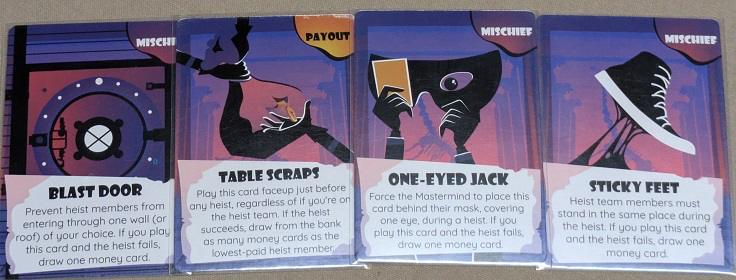
Another element of challenge are the skill cards. These are dealt out to the players and refreshed after each heist. They can be played to add new abilities and boosts before a score, such as allowing players to come into the vault from the top instead of one of the sides. But they can also be played to increase the difficulty, which occurs often courtesy of those not chosen to be part of the burglary team. These effects are wild, such as requiring a player to place a card over one eye, or halting the group from physically moving around the table once the heist begins. These can be piled on each heist, making a difficult game even more brutal.
This leaves Tiny Laser Heist in an awkward spot. It’s a novel thing, something that is a spectacle to behold and obnoxiously fun at times. But it’s also frustrating and unrelenting, often beating down those who are most vulnerable. It’s a difficult sell due to these characteristics, requiring an open-minded group that is amenable to the punishment while able to find joy in the nonsense.
Maybe.
If the nonsensical nature sounds appealing, and if you have a stomach for challenge, certainly give it a go. Under any other circumstance, it’s likely to burn down the house. You could give it a try if you liked Kabuto Sumo, which is indeed a different beast, as it’s a more meditative and precise activity. Yet both games share a sense of physical novelty that is quirky and unequalled. They both contain that spark that behoves showing these games off to newcomers, as they’re both unlike anything else out there.
Publisher: Evan and Josh’s Very Special Games Company
Time: 30-120m
Players: 3-6
Ages: 8+
Price: £38