
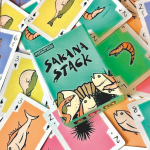
Sakana Stack is a quirky card-shedding game set in Tokyo’s Tsukiji Fish Market. With trick-taking vibes, light strategy, and plenty of charm, it’s a fun, fast-paced game—perfect for fans of The Crew looking for something a bit fishier
Written by Chris Lowry
As a vegetarian, I’ve only been fishing once, a conflicted afternoon spent desperately hoping not to catch anything. Not once did I find myself outraged at a lack of shrimp or desperately hoping to get my hands on pufferfish; poor preparation indeed for the experiences Sakana Stack offers. As rival vendors in the Tsukiji Fish Market, you aim to offload all your produce cards before your competitors, and to do so in quantities they can’t hope to match.
Related article: Sea Salt and Paper review
The mechanics of this card-shedding competition are similar to the winner-takes-all approach of trick-taking; you take it in turns to place a stack of fish cards. If you can place a stack with a total value higher than the previous player’s, theirs is discarded. So, if your precursor played three shrimp and three pufferfish, a single eight pufferfish card would come out on top.
There are two twists in the tail; firstly, your stack must contain the same species as the top card on your opponent’s deck. So if they’ve worked out what delicacies you are short of, they can take you to town. Secondly, if you can’t place a stack, you pick up an extra card, the previous player “scores” one of the cards from their stack and the next person has a go. This means the stronger stacks progressively get smaller and easier to beat. It also means you can choose not to beat a stack if the available extra card is particularly strong; gambling short-term losses for a future win.

The game ends when any one player runs out of cards, or when the discard deck has run through twice. Each player counts their scored cards; just the amount of total cards, not their value. So scoring two “1” cards is actually twice as valuable as a single “10”—you are looking for quantity over quality.
Little box games are often rather moreish, and we played a lot of Sakana Stack on our recent family holiday. It’s slightly tighter and skill-based at lower player counts, but you still find yourself powerless in the face of unhelpful card draws somewhat too often for those hunting for truly strategic battles.
The ability to elongate the game by picking up extra cards to give stronger hands later on adds some needed player agency. As we gained experience, it became clear that choosing to grab extra cards when they were high numbered was a game-winning approach; yet still one with enough mystery to be fun—do I pick up a “7” now, or attempt to score with a “6” instead?
Opinions were mixed on the appearance of the cards; one person’s lo-fi hand drawn aesthetic is another person’s simplistic and unexciting. I thought the game looked simple and charming, whilst my wife described it as “deeply beige”.
Still, if you are looking for a simple, lucky-heavy card game to dive into with a group of friends over a weekend, then Sakana Stack is definitely worth considering. For my taste though, it’s slightly too dependent on random chance to have true staying power. Not to forget that there are definitely better games you can play with a normal 52-card deck—and then you’ll never have to come face-to-face with a devastating lack of shrimp ever again! 
Maybe. It’s a simple card game to enjoy, play, conquer and then set aside. It may not have much longevity, but it’s charming in its own way.
You should try this if you like The Crew, as the trick-taking element of The Crew is somewhat present here, although at least, thankfully, you are allowed to actually talk to each other in Sakana Stack.
Designer: Mike Petchey
Publisher: Huff No More
Time: 15
Players: 3-5
Ages: 8+
Price: £15