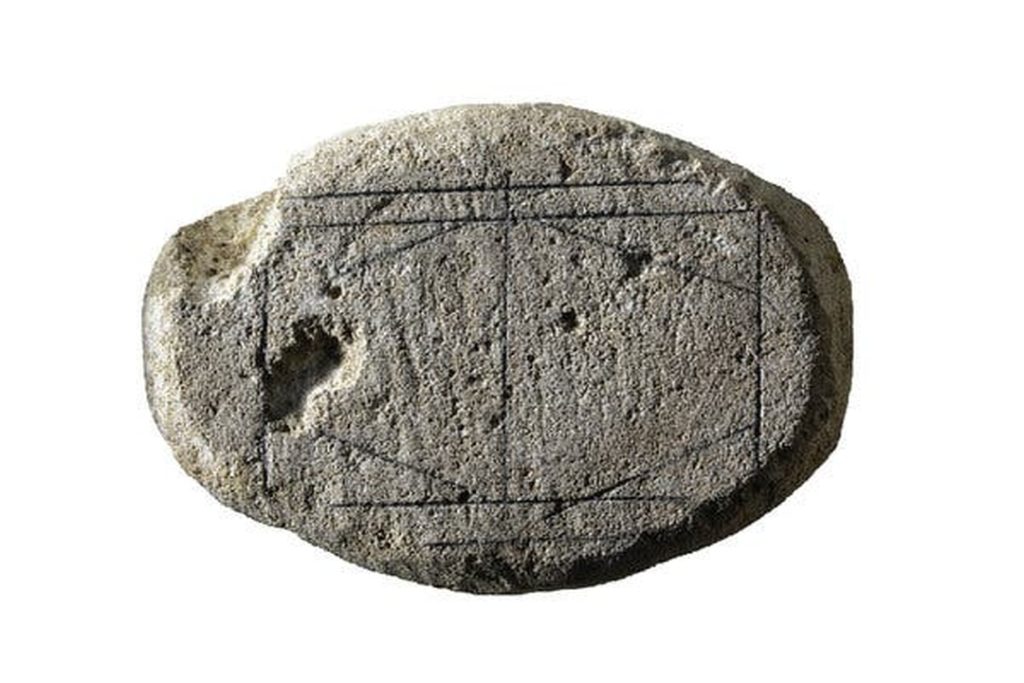

AI has learned the rules to a forgotten Roman board game named the Coriovallum game
What looks like a broken chunk of limestone architecture salvaged in the late 19th- or early 20th-century is actually a Roman board game called Coriovallum. That claim is made by Walter Crist, an archaeologist at Leiden University in the Netherlands and the lead author of a paper published in February 2026, who came across the piece in the Het Romeins Museum in the Netherlands.
Dr. Crist, a specialist in ancient games, was drawn to this small, worn rock because of the peculiar pattern of rectangles and lines etched on the oval-shaped slab during a visit in 2020. When he examined the surface, he saw distinct signs of wear, indicating that the stone may actually be a well-used board game.
“Players had, over and over again, pushed game pieces across the rock, indicating it was far more than mere decorative graffiti,” Dr. Crist told the New York Times. Using high-resolution 3D scans, researchers were able to map microscopic imperfections and telltale grooves. “Those lines indicated the most heavily played routes,” he added.

This data was fed into an AI platform called Ludii, which has been trained to play roughly 100 other board games from ancient Rome. By running thousands of simulations against the grooves on the board, researchers matched the rub marks to nine plausible sets of rules, suggesting that the most likely pattern of play was a blocking game that required trapping an opponent in the corners of the board.
While games that require complex blocking strategies were thought to have emerged much later, in the Middle Ages, Dr. Crist said the reconstructed game likely involved two players sliding small pieces of glass, bone or earthenware along the lines, with one party trying to immobilise the other.
The game has been called Ludus Coriovalli or the Coriovallum game, as the Het Romeins Museum is based in the Dutch city of Heerlen, formerly the Roman town of Coriovallum. Gamers can now try the game out for themselves by playing against a bot on the Ludii AI platform.
Could other unidentified items found at Roman sites also be game boards waiting for their rules to be rediscovered?