

Now that we can (very nearly) get back together, we’re counting down our favourite party games ever.
Words by Anna Blackwell, Matt Bassil, Alexandra Sonechikina, Simon Castle, Glenn Ford, Ben Maddox, Charlie Theel, Dan Jolin, Paul Wake, Matthew Vernall, Mark Cooke, Chad Wilkinson, Charlie Pettit, and Christopher John Eggett.
Watch Part One of this HERE!

Designer: Matthew Inman, Elan Lee, Shane Small
Publisher: Exploding Kittens
Price: £20
Ah, Exploding Kittens. Until Frosthaven gracefully transferred the crown atop its furry head to its own, it was the highest funded game on Kickstarter, and sells in everywhere from Friendly Local Game Stores to high street supermarkets and bookstores. That means both that it’s got a popular following, but also you’re likely to already have a group familiar with the rules – one step in negotiating a party game, ticked with a capital T.
The rules themselves are simple – don’t explode. Save yourself by prompting others to explode. Diffuse, avoid, and run away from said potential explosion. So, easy, we can tell you straight away it’s the blue wire, and avoid all of that tension in the middle. Right?
Of course not, that’d be no fun at all. This card game instead gives you a hand that includes a diffuse card, (to use if the exploding card appears, of course), and then a random combination of other cards. These might give you the power to see ahead in the deck (and perhaps find a bomb!) maybe a skip card (to then skip the bomb!), or even just powers in combining pairs – steal cards, request cards, and the like.
There are two great joys in this game, one being the Oatmeal artwork that is quirky and engaging, and the other being the Nope card, that prevents the other players from taking an action. There is little more satisfying than a player smirking at you as they lay what they believe to be the perfect card down to make your card playing life infinitely more difficult, only for you to be able to shout a triumphant ‘NOPE’ at them, with a definitive overturn of your own card, scuppering their plans and transferring the smugness instantly from them to you. These moments of attack or defence, amidst brightly coloured charming cards, are where hilarity ensues, and what places Exploding Kittens firmly atop the party game shelf.
Charlie Pettit

Designer: Kate & Zak
Publisher: Guttergame
Price: £25
Hollywood has, and continues to be, a huge source of Americanisation. An unstoppable shoggoth that spreads its language and customs into everything it touches and while there are some things that are best left across the pond, the image of the American college party is a welcome addition.
With their little red cups, beer pong, keg stands, and ska music, these parties were leagues ahead of the typical UK affair. So when we saw Beat That all set out at UKGE a couple of years ago, we literally leapt with joy.
The game contains: reinforced red plastic cups, ping pong balls, plastic chopsticks, a measuring tape, sticky notes, dice, a timer, and betting chips. Each round, someone draws one of the challenge cards which could be something like “place a cup over each hand and stack four dice on top of each other in 30 seconds” or “gargle a song while your partner tries to guess it”. Before players start their attempt, they bet a number of their chips with the ultimate goal of banking the highest value of chips by the end. Succeed, and you bank the wagered chip; fail and it’s gone.
With solo challenges, battle royales, head to head, and team trials, Beat That keeps things fresh and exciting throughout. To the point that we – and you will as well – were loudly cheering and still reminisce of an amazing off the wall ping pong shot that circled the cup for ages before falling in and winning a high stakes bet. You had to be there.
Very few games become a staple part of our “all ages party game collection” but Beat That has been a must for every party since we got it and is one of the few non-Big Potato games to earn such an honour.
ANNA BLACKWELL

Designer: Jack Ford Morgan
Publisher: Half Monster Games
Price: £20
After Cards Against Humanity revealed that we’re all a little sick, it was a no-brainer to pick up Trust Me I’m A Doctor.
This weird little party game follows the Cards Against Humanity format of having each player play cards to make the funniest result as chosen by the patient. But rather than just filling in the blanks, players are instead given real historical cures and treatments that they must combine and improvise about in order to make them fit whatever real ailment the patient of the round has presented. Players are then encouraged to act like olde timey snake-oil salesmen and big up their cures while denouncing the others as frauds and charlatans which is my favourite part.
In one round, the patient played the impotence card to which the first doctor enthusiastically and confidently explained that impotence was caused by jealous elves. The cure? A concoction made of special berries which fairies despised and flagellation of the genitals, of course. The jealous elves epiphany led us down a rabbit hole of some doctors agreeing with the diagnosis while others decried it as superstitious tosh as it was clearly the work of Satan.
Trust Me I’m A Doctor goes the extra mile to inspire your creativity as while the core gameplay is thankfully loose – essentially just match your treatment’s icons to the icons on the patient’s ailment card – each card has a picture sourced from a historic medical textbook or advert in the case of some newer ones. With treatments and ailments ranging from the middle ages to the 1900s, there’s a lot packed into this little game and much like Cards Against Humanity, repeat pairings end up becoming an in-joke that makes everyone except the newcomer buckle with laughter. Though thankfully such joylessness can be cured with a bowlful of ale and some exploratory surgery.
ANNA BLACKWELL

Designer: Ted Alspach
Publisher: Bezier Games
Price: £24
Werewords works because it’s familiar. This is group 20 Questions with a traitor. Really, it’s that simple.
A free phone app displays a word that one player reads. It’s also then read by a hidden werewolf in the group whose goal is to foil the game. All of this is handled with closed eyes in a night round, reminiscent of classic Werewolf.
The game proper is a bit chaotic and rushed due to the pounding timer. Players take turns posing questions such as “is it smaller than a breadbox?” or “Is it an animal?” The game can take wild turns as the group narrows the solution down and races the clock.
All the while the Werewolf is trying to eat up time and steer the crew in the wrong direction. They can’t sabotage the game too overtly, however, as everyone will have a final moment at the game’s end to vote on who they think is the werewolf. Whichever player receives the most votes is lynched, possibly resulting in the villagers’ victory if they pen the culprit.
This game is wonderful and brutal and full of drama. Additional roles – lifted directly from Werewolf – can be tossed in to vary play and shift the dynamics. The Seer for instance is another player who gets to see the word in the night phase, but they must not be too obvious in their knowledge for the Werewolf gets a chance to pick them out for the win in the finale. It all holds together and the puzzle keeps evolving.
I’ve seen devious plays such as the Werewolf guessing the correct word, only to snatch victory by then successfully guessing who the Seer is in the final phase. It’s a very clever experience that rewards players immensely, and it all wraps up in less than 10 minutes. This is one of those games you can pull out for a short stint, only to realize the sun has long gone down and hours have ticked away.
CHARLIE THEEL

Designer: Jordan Draper
Publisher: Jordan Draper Games
Price: £40
Once you wear the pin of the Tokyo Game Show Host, your life is changed. You’re no longer a mild mannered games enthusiast – instead, you’re the heart and soul of a game all about silly and amusing tasks that your friends are going to try and complete for points. And what do points mean?… Sadly there aren’t any prizes in the box, but there is the pride of having been the best at describing a visiting dead person, finding all the best tokens quickest, or catching tumbling dice.
This is the definition of a box full of party games – it’s a whisker shy of expecting you to hand out favour bags with a slice of cake in it and a party horn at the end. The games inside all use a series of minor props that are in strokes interesting and absurd. There’s the coloured wrist bands, a number of coloured cards, a handful of dice, and even some glow in the dark tokens. The host picks the games beforehand, or more likely, on the fly in a fit of Richard O’Brien’s Crystal Maze style mania, and challenges the group to word games, dexterity games, and the occasional treasure hunt.
Really there’s few games that ask everyone to leave the room as the host sets up it up, or turns the lights off so that the glow in the dark tokens can be handed out – and any game that does these things tends to break down that ‘gamey’ barrier into simple and undiluted fun. There are 63 games included in the box, so silliness can be injected into an evening over and over again with minimal repeats. If you’re willing to give up any pretence at a cerebral challenge beyond thinking of something funnier to say than “aliens with floppy femurs” this is a perfect way to slip light and surprising fun into an evening.
CHRISTOPHER JOHN EGGETT

Designer: John Kovalic, JonMichael Rasmus, John Sams, Sean Weitner
Publisher: Renegade Game Studios
Price: £10
This early title from Renegade Game Studios was released back in 2015 and unfortunately seemed to slip under the radar for most people. Admittedly, the studio was yet to reach the heights of success and renown it enjoys today, but as the sole trivia title in their catalogue – and a unique one at that – it’s worth a revisit.
Double Feature describes itself as ‘the movie game for everyone’, in the sense that players need only come armed with knowledge of the films they’ve seen.
The aim of the game is to name a film which links together the two category cards played each round. The six categories can range from characters and props to scenes and settings, with each featuring some brief text on the card’s reverse.
Each round the ‘director’ will choose a new category card to replace a previously scored one, adding it to the table. Upon reading the two cards players must then race to name a film which the ‘director’ deems worthy of linking the two categories. For example, one card might read ‘ In New York, Chicago, or Los Angeles’ and the other stating ‘There’s a dream or fantasy sequence’, with one player shouting “The Big Lebowski!” for the point.
It’s all very simple but this is what makes Double Feature such a success in nearly every party situation. Everyone watches films, and I’m sure most people can recollect a film when given a few categorical boundaries. In fact, the largest challenge here is often being quick enough or loud enough once you have an answer.
Interestingly, success often hinges on the knowledge of a particular round’s ‘director’, leading to some unexpected strategy when coming up with films you’re certain they’ve seen. Indeed, players attempting to show off their vast knowledge of obscure European independent cinema might find their pretensions backfiring.
Overall, Double Feature is great party title for friends and families, and crucially manages to work well for both the young and old.
CHAD WILKINSON

Designer: Mike Boxleiter & Tommy Maranges
Publisher: Goat Wolf & Cabbage
Price: £40
You’ve opened your eyes as a liberal player, and sat around the table are your friends and fellow players. Except two of them are not as they seem. Two of them are fascists, specifically, one being Hitler, and one being his chancellor, though you cannot tell at this stage which they are, and only they know of each other, after being randomly decided at the beginning of the game by a card draw. You’re going to have to try to call them out based on the policies they’re trying to pass with every card they lay down, but in this time period of Germany, those cards are stacked in the favour of the fascists, and they may have no choice but to pass a fascist policy. You question them – did you have a choice in which card you lay down? No, they say, but you cannot be sure. Are they truthful, or are they a wannabe dictator in disguise?
Secret Hitler is a game that many are put off by simply because of the name. Whilst understandable, it’s a shame, because it’s an incredibly clever little social deduction game. At every turn you’re scrutinising the moves of the others, trying to track whether they’ve just been unfortunate with the cards they’ve been dealt, or are stealing sneaky looks to their chancellor across the table – or indeed, trying to conceal your own sneaky looks and liberal cards. The dual layer of distrust in both the persons role, and then suspicions through the cards, and the impact of passing too many of one kind of policy, brings it together in a well balanced game where you’ll rarely be 100% certain of any accusation made. If your idea of a party is shouting at your friends, this is the one to do it with.
Charlie Pettit

Designer: Carey Grayson, Randy Nash, Rick Soued
Publisher: Eagle-Gryphon
Price: £50
There’s no mistaking the loud clatter of a fistful of dice bouncing down the stepped board of Tumblin-Dice. I remember my first time encountering this. I was wandering around at a convention many years ago, and I heard that unmistakable noise followed by cheers and curses. As the group came into view I noticed they were throwing down money and placing bets on the game, completely caught in the throes of cascading dice.
This one can really sink its teeth in. Players take turns rolling their three six-siders, one die at a time. You’re trying to gently bounce the cube down the board, landing near the bottom for the highest amount of points. You multiply the value on the board with the number you rolled on the die and add to your accumulating total. Easy.
But you don’t score until everyone is done for the round. This means later players can viciously toss their dice in an attempt to unseat the most successful rolls. If you’re bumped off the board you score nothing and must wallow in misery. It’s wonderful yet cutthroat as only silly games of skill and chance can be.
You play this thing round after round and it becomes enveloping. No one wants to quit. It’s enthralling as it’s a simple task, and much like the game of golf, a really well placed shot warms the soul.
This is kind of a weird one as you have to haul around a big box with those large wooden boards. This makes it more of an event than something simple and quick to break out. But it always succeeds in this unique role and will land successfully with just about any individual. In short order you will be adding in new dice and house rules, looking to up the ante as Tumblin-Dice takes firm hold of you.
CHARLIE THEEL

Designer: Frédéric Henry
Publisher: Asmodee
Price: £14
Remember when you were a kid and you had to learn 30 historical event dates for the school pop-quiz the next morning? Shudder at the thought. But slap those dates on a bunch of beautifully illustrated cards and dare your friends to see who could arrange them in a correct timeline first, and suddenly we have a highly entertaining (and educational!) game. Timeline is so simple to play, it’s practically all in the name!
Timeline has many different themed decks, ranging from science and histories to pop culture, so everyone can find something to their liking. Maybe you are not so well-versed in the dates of the Napoleonic Wars, but can perfectly trace the releases of iconic Hollywood movies, in which case Timeline: Music & Cinema is a better choice than Timeline: Historical Events. You can also mix various decks together for an extra challenge.
The start of the game may seem easy: with only few cards on the table, you just need to place your event within the correct time gap (knowing actual dates is not a requirement, thankfully). But it gets more difficult towards the end, as the timeline gets busier with cards and the gaps between events get smaller. At first, you could guess within a ballpark of a century, but during the end game a couple of years can make all the difference!
Timeline is not just simply a pop-quiz in a friendlier presentation. Of course, you can learn a lot – how much you will remember a few days later is a different issue and a bonus for the game’s replayability. Yet there is also something uniquely satisfying in arranging events in a timeline, making silly goofs or getting things right, showing off your knowledge and discovering something new, with an added drop of healthy competition.
ALEXANDRA SONECHKINA
Designer: Bez Shahriari 
Publisher: Gigamic
Price: £12
Have you ever tried to pick up a card whilst simultaneously balancing another hand on the back of your left hand, keeping your right pinky pointing down, whilst your ear is touching your shoulder? These are the kinds of situations players will find themselves in whilst playing Yogi.
I came across this game in its original form, In A Bind, and carry the deck with me regularly. You never know when a quick bit of silly fun might be needed! We were also very privileged to run a game of In A Giant Bind at AireCon a few years ago, with super-sized cards and even sillier challenges, custom made by the designer, Bez. We even ran a tournament, with people drawing up to seven cards before it all went wrong.
The rules are simple, draw a card, do what it says on it until the end of the game. If you ever stop doing what one of your cards tells you, you’re out. Last player standing wins. And often they’ll be standing on one leg with a card held above their head and their chin trying to hold a card to their shoulder.
It’s great fun at parties, in pubs, at conventions and is sure to get people laughing and gathering around wondering what’s going on. As games are short, people can also join in at any time, and it’s very likely that you’ll play multiple games in succession.
MARK COOKE

Designer: Ben Beecher, Trevor Moorman, Justin Quick, Brad Sappington, Joe Sklover, Max Temkin, Chris Weed
Publisher: Gnarwhal Studios
Price: £25
Have you ever collapsed in laughter after witnessing the painful repercussions of a friend accidentally slapping a horse? No? Well, Slap 45. might be the safest – and least cruel – way of doing so.
This little known dexterity card game was Kickstarted in 2015, with design and production duties being handled by the people behind Cards Against Humanity.
The game’s premise is essentially replicating an old Western stand-off, albeit with Blazing Saddles levels of hilarity.
Three to seven players will take on the roles of rivalling gangs – such as ‘The Poncho Posse’ and ‘The Comanche’ – and attempt to be the last ones standing after a series of tense shootouts. Each gang comes with their own home base detailing their unique special power, and six gang members who, of course, will rapidly dwindle as the game progresses.
As the name might suggest, the key mechanic here is slapping. Each round simply involves flipping the top card of the deck and being the first to react, often by slapping your hand upon it and gesturing pistol-fingers toward an opponent. Play is simultaneous, turning each round into a mad flurry of hands, gasps, and pained shrieks from inevitably slapping too hard.
Whipping out pistol-fingers isn’t the only road to victory though; often it’s more satisfying to watch your opponents slam their hands down on a horse instead of a six-shooter or cannon, and watch their gang peter out that way. Other cards come into the mix too, such as gold (used to activate special powers) and my personal favourite; the throwing knife. Unlike the pistol, merely slapping and pointing won’t finish the job – this card must be thrown at your foes. Being a flimsy, linen-finish flap of card, this goes as well as you’d expect, although landing a particularly fine shot will have Slap 45. prompting triumphant roars at a volume unparalleled in the tabletop hobby.
The real joy of Slap 45. though is witnessing the final showdown. Just two weary players, a designated dealer, and tension so thick you could slap it. Perfect.
CHAD WILKINSON

Designer: Ken Gruhl & Quentin Weir
Publisher: North Star Games
Price: £15
Happy Salmon and its even slightly sillier sibling, Funky Chicken, is the sort of frantic, no-turns shouty jumpy party game that feels as though it always existed in children’s parties of your past but didn’t. Right from when you pick up the £10 package wrapped in a grinning salmon shaped bag, you know this is a game that doesn’t take things entirely seriously. Coming from North Star games and named after the greeting that designers Ken Gruhl and Quentin Weir created (which is a little complicated to explain in words, but involves mutual forearm tickling) it consists of stacking some cards with actions such as “high five” or “fist bump” in an open palm and calling out your action until someone matches and performs it with you so you can discard your card, first to discard everything wins. Games are shouty and end up with the very resilient cards scattered all over the floor and nearby furniture, overly vigorous fist bumping or switcherooing in closed quarters needs to be done with a little care, we’ve suffered one or two family Christmas fist bump injuries in our time playing this one. Games generally take a minute or so of raucous fun before all the cards get scooped up and everyone goes again. As a nice touch the rules include optional variations for playing silently using sign language or while sitting down, allowing the hard of hearing or those with mobility issues to join in, or just so that parents can get kids to play in absolute silence while they sit in a quiet room nearby. Fun for small children, the young at heart and the more than slightly inebriated, this is one that we pull out most Christmases, prior to the turkey coma.
GLENN FORD

Designer: Wolfgang Warsch
Publisher: Stronghold Games
Price: £20
Secret partners in party games often add up to a lot of surprises. Thinking you know who is thinking just like you – only to then reveal that they’re barking up an entirely different tree – is both humbling and hilarious. And it’s also the is the spice of Subtext.
Subtext is another drawing game where plays have to give everyone a hint, but not too much of a hint, about the object on their card. The leading player picks a card, memorises what’s on it in, and then draws as many cards as there are players, minus one. These new cards are shuffled with the original card, then dealt out.
Then the fun begins. Everyone draws a hint to the clue on their card, hoping that they, in fact, have the card that the leading player originally had. Or at least, that it can be read that way. Once everyone has drawn their hint, players bet on which ones match the card drawn by the leading player. Get it right, you get points, get it wrong, you get nothing.
And again, it’s the funny meander through trying to give just enough away without giving it all away. A clever and astute scribble that lands with the right person can feel like magic. Or it can fall flat on its face.
While really it’s down to how well the room knows one another, and the kind of weird tangents everyone else relies on, there is a competition in here. It’s a party game with a proper thrill in its heart, because, you might actually want to win this one.
CHRISTOPHER JOHN EGGETT

Designer: Jun Saski
Publisher: Oink Games
Price: £19
Pictionary, but fun, is a well-worn category for games on this list. Drawing games that don’t require too much beyond the skills of Ug and Zugg of 30,000 BC are usually elevated by some spicy wrinkle in their design. Telestrations asks you to whisper, and A Fake Artist Goes To New York asks you to fake it until you make it.
One player plays the part of the question master, who announces the general category, and then writes down the specific title of the piece that everyone is creating on wipe clean tiles. These are then distributed to everyone around the table. Except for one person, who gets a blank tile, and is therefore the fake artist. Everyone then takes turns adding a single line to a piece of paper, drawing the piece collaboratively. Except, of course, if you’re the fake, then you’re going to have to bluff it with a line. After a second round of lines have been added, players get to out the fake artist with a bit of pointing. If the fake artist escapes being discovered, or is discovered, but can name what the title of the piece is, they gain some points along with the question master. Artists only get a point for finding the faker.
And it’s a joy to sit there and giddily (on the inside) add a squiggle to the picture that you’ve really got little idea as to the subject of. Equally, it’s hilarious to be quite sure that your friend is the fake, because surely they don’t think that a seagull has a beak like that, right?
There’s plenty of versions of this game floating around (Drunken Sailor for example) but there’s nothing quite like the beautiful and tactile nature of an Oink game at the table.
CHRISTOPHER JOHN EGGETT

Designer: Gaëtan Beaujannot & Alain Rivollet
Publisher: Repos Productions
Price: £27
Concept is a bit like Charades… Hey what are you- WAIT NO, WAIT, COME BACK! It’s a bit like charades, BUT it’s very much a cleverer, slicker, more enjoyable game.
Concept is a guessing game where, by placing a series of delicious-looking coloured cubes across a board that’s covered in symbols, you must communicate a clue to the other players.
You have a few more tools than that at your disposal – you can also use different numbers of cubes to convey relative importance and different coloured cubes to try and separate different aspects or ideas – a necessity at times because while it’s straightforward enough to spell out a word like apple (food symbol, round symbol, red symbol) how do you communicate nostalgia? Or the phrase “I think, therefore I am”?
Concept is one of those games that encourages creativity and creates instant humour by placing heavy restrictions on communication. It’s surprisingly intuitive to play, a quick scan to get to know the board and you’ll soon find elegant ways to string symbols together springing to mind. Whether your friends will guess correctly is another matter though. It’s common to flesh out an idea in precise detail, using fistfuls of cubes to convey every single facet of a more complicated concept and then watch in despair as your teammates entirely fail to hop aboard your train of thought, instead careening off a cliff of distraction to crash and burn in a valley of confusion – inevitably much giggling ensues.
Perhaps more of a family game than a party game – Concept is simple to teach, making it very suitable for children or usually boardgame-averse relatives. But it works in large groups too and can be a great icebreaker – what better way to get to know someone than to try and get inside their noggin?
MATT BASSIL

Designer: Jack Dire
Publisher: Skybound Tabletop
Price: £20
You know when a kid will pipe up sometimes with an epic question like “who would win in a fight between a T-Rex and Superman?”, then “okay, but what if that T-Rex had laser eyes?” and then “okay, but what if Superman had the T-Rex version of Kryptonite?” (we’ve all been there). This game takes that idea and makes it into an adult party game, having you arguing over absurd topics with friends in little to no time at all.
With a tiny scrap of paper to make up the rules, you’ll simply draw one white card (which will contain your fighter), your black card (your superpower or situation), and set to work arguing why your bonkers concoction would win in a fight with your fellow players equally bonkers fighter. Partway through though, you’ll pick up another black card, and have to expand your original argument.
For example, my pet rock can travel through objects, and I’m arguing against a dragon who can summon cats to do their bidding. At the draw of the next card, my pet rock also has a moustache that can stretch and move at will, but now the aforementioned dragon is drunk. My opponent will have to convince the other players that they are in a perfect position to beat me. So if you like games that have you arguing nonsense as an icebreaker, this really ticks the box.
Charlie Pettit

Designer: Kasper Lapp
Publisher: Sit Down!
Price: £24
Most party games are competitive and clamorous. Magic Maze isn’t like most party games. In fact, if the neighbours have been complaining about the noise, then it’s the ideal party game. Because it’s a game in which silence is golden.
The theme is a bit of a jumble: up to eight players must work together to help four fantasy heroes perform a raid on a modern-day shopping mall. Huh? But don’t worry about that. It’s the unique gameplay that’ll win people over, as everyone works simultaneously to move four pawns firstly to their own destinations, then to an exit point on a tile-based maze that is revealed one tile at a time. Each player can move any pawn, but only according to the action tile they currently hold. For example, move north, ride an escalator, or add a new maze tile.
But there are two complications. First, if the three-minute hourglass runs out, you all lose (you can extend your time by putting a pawn on an hourglass space, but this also means action tiles have to be passed to the left). Second, nobody’s allowed to communicate verbally, or even point at the board. The most you can do is take a large, red “Do Something!” pawn and plonk it (not too hard) in front of another player. Though “staring intensely” is also permitted.
It all makes for a game of iron-hard group focus which is also, somehow, a laugh to play. Of course, you have to try and not become too frustrated if someone on the team messes up or freezes, but at least they won’t get shouted at. More often than not, each game will end with tension-easing laughter and enthusiastic discussion, before you dive back in with the next maze-tackling scenario and the neighbour-pleasing silence descends once more.
Dan Jolin

Designer: Zoe Lee & James Vaughan
Publisher: Big Potato
Price: £20
A strong entry into the ‘it’s basically a game about small scale pranks and banter’ section of any good party games list, Don’t Get Got is a game that’s going to take over your day in ways both subtle and hilarious. Not only that, but you kind of need to actually have a party to play it, rather than a games evening with the tone set to silly.
Each player is dished out six secret missions at the start of the game, which could be anything from as people have arrived at your party, in the morning on Christmas day, or at the start of a day out. These secret missions are things like ‘make something, and get someone else to wear it’, ‘hide this card on someone else (without getting caught)’ or ‘get a player to flip a coin until they get heads’ – and once the missions are distributed it’s game on. Until when? Until someone ‘gets’ three of their missions done by tricking other players. This could within the hour, or, possibly, days later if it all gets a bit paranoid.
Winning the game is usually about very casually tricking people into doing things (usually by getting them to be helpful) while also not pushing it and ending up acting very weirdly. Walking this line is particularly good fun in longer sessions, as players will come and go from remembering they’re playing the game. Can you get someone to open a jar (with your card in) without it seeming too strange? Probably, if they’ve forgotten that they’re playing. Once they’ve been got however, you probably won’t be able to get them to pass you the salt anymore. If you want a party game that can seep into every part of your evening or outing, then there’s nothing better.
CHRISTOPHER JOHN EGGETT

Designer: Anthony Conta
Publisher: Mattel
Price: £16
Nobody likes job interviews. The stress, the necessity to read and re-read your CV, it’s a nightmare. So you know what’s an incredible cathartic game that lets you and friends make fun of this miserable experience? Funemployed.
In this light hearted, card-based improv game, players take turns applying for random jobs with random qualifications. One player takes the role of the interviewer and either randomly draws or selects a job role the other players will be applying for, with jobs such as Butler, Taxi Driver or Super Villain. Once decided, all players are dealt skill cards and ten more are displayed face up on the table, which players can freely swap with cards in hand until they’ve built a hand of four. These qualifications are perfectly normal, like “Self-entitled,” “Fifty Tattoos” or “Chainsaw.” Each applicant player is then interviewed, using their cards as justifications for their answers (“Well you see, as a Super Villain, identity is important, so by having fifty tattoos I’m highly likely to be memorable.”)
This slight tweak to the usual “random jokes on cards” format that made Card Against Humanity a problematic favourite, improves the game for everyone. Without having to rely purely on shock humour, players are encouraged to get silly, using cards as aids instead of answers. Slowly revealing a trait like “Pyromaniac” when applying to be a Motivational Speaker will cause your room to explode with laughter.
The wide array of jobs and skills included show the designer’s deep level of commitment to fashioning a selection box of comedy starters, though if you want to play this with family you may want to remove some of the less “PG” friendly cards. In any case, if you’re looking for a giggle that gives everyone a chance to shine, Funemployed is definitely worth a look.
MATTHEW VERNALL

Designer: Vlaada Chvátil
Publisher: Czech Games Edition
Price: £17
Pictionary is one of the classic party games for a reason: laughing at your friends’ attempts to draw things under pressure, and competitively guessing what the horrible squiggles they produce are meant to be, is great fun. It’d take a brilliant designer to evolve on such a core concept.
Fortunately, there’s no question that the famed Vlaada Chvátil (designer of modern classic party game Codenames, among many other games) is up to the job.
The terrible drawings and speedy guesses at the heart of Pictionary are still there, but every rule around that carefully improves on the classic. Rather than taking it in turns, everyone gets to draw simultaneously, and you don’t need to be the fastest to be able to guess at everyone else’s – you’ll just get more points if you’re the first correct guess.
You’re only allowed to start guessing once you’ve put your pencil down, committing your own drawing where it is, which means faster sketches are rewarded – at least until no-one guesses yours correctly. Then you start thinking about how everyone’s subjects are assigned allows for a spot of deductive reasoning…but now you’re risking spending too long applying a process of elimination. This is a drawing game with opportunity for strategy and tough snap decisions – but still with the opportunity to win by just drawing and guessing well.
And if all this is sounding interesting but maybe just a little dry for a party game, just wait for when the third and fourth difficulty level cards get put out. After a first couple of rounds drawing things from object categories like Fruits or Animals, you’ll move on to sketching specific emotions or “Forms of Writing”. Even just seeing the subjects is likely to make your group start laughing at the sheer idea of depicting any of them; when you start seeing your sketches and your guesses, it’ll be as raucous as any other game on this list.
SIMON CASTLE

Designer: Roberto Fraga, Yohan Lemonnier
Publisher: Asmodee
Price: £45
Captain Sonar is one of the best team games ever made. You and up to three friends sit on one side of the table with four enemies sitting across. Each group operates a military submarine with each player performing various roles such as Engineer or First Mate. The crews are separated by a large divider, creating a sort of group Battleship feeling. The tension and energy is powerful.
This game just delivers on its lively premise. I’ve had games where the coordinated strategic discussion was broken by players hurling gummy bears over the separator, laughter punctuating the hushed discussion and then the status quo broken again by a Captain yelling “Fire!”
There is an element of camaraderie at work which produces these moments of excellence. To succeed you must work together. Each role in the ship feeds into the effort and positioning of the whole. The Captain forms the connective tissue of the moving parts, shouting orders to the crew and attempting to make sense of the real-time chaos.
The most interesting role is that of the Radio Operator. This person sits with a map and simply listens to their opponents verbal discussion. They attempt to map the enemy’s movement – Captains must verbally declare which cardinal direction they are moving with each action. It feels as though you are decrypting and relaying communications to the Captain, all the while people are dropping mines and launching torpedoes.
Everything comes together so well. When you connect with one of your attacks, blindly firing into a grid coordinate, it feels special in a way few games manage. The information filtered by your Radio Operator connects with preparation completed by the Engineer and First Mate, all pushed through the central node of the commander.
This game can be an intimidating experience for a newcomer. There’s a temptation to teach using the optional turn-based variant. The problem is that the magic of Captain Sonar exists in the friction and mess created by rushed decisions and building pressure. It’s a game you need to just dive into and fumble around, eventually coming out the other side a grizzled veteran.

Designer: Kristian Amundsen Østby
Publisher: Queen Games
Price: £40
You know that scene in Indiana Jones, where the ball rolls towards him in impending doom, and there’s a mild panic that poor Indy may not make it out of this one…that’s is basically the whole vibe of this game, in the best way. As the title suggests, you’re going to need to escape the temple, but not without your treasure. Roll dice to meet the conditions to open a new room, and lay a new tile down in that direction, before making your way to the exit before it’s too late. Sounds lovely and delightful.
Except for the indescribable mounting panic that the game impressively builds. You’ll play a CD track (or if you’ve moved too far into the future and don’t own a player, you can find it on their website), that times you to exactly ten minutes to escape. Part way through, you’ll hear gongs sound, where first, you’ll have to race back to the starting chamber or lose one of your dice, and at the next, escape.
That’s stressful enough, but then come the dice. This game is a simultaneous play game, so everyone is frantically rolling their dice as quickly as possible to try to meet conditions of each room, losing dice on some rolls, recovering dice on others, and there’s a real tension made up of the culmination of music, the time limit, and the repeated hit of dice on the table. If your team splits up in its exploration, you’re even more hyper aware of everyone, everywhere.
The fact is, stressful as it becomes, it’s immensely fun. You’re constantly rolling, shouting for more dice, squealing at the time pressure and failed rolls at a pivotal time, with everyone doing the same around the table. Sure, you could go do physical exercise to raise your heart rate, but why would you when you can play this joy of a game?
Charlie Pettit

Designer: Andrew Bryceson
Publisher: Tomy
Price: £33
Maybe one of the most mainstream games to appear on this list, in a sort of ‘you can get it in the supermarkets at Christmas’ way. While one day we’ll see more hobbyist games in Tesco, for now, Articulate! is the one for us. While word games can sometimes be a challenge for those of us who are performance adverse, Articulate! is more about how you think than what you know.
Two teams take turns describing a word to their collaborators without saying that word, giving away how many letters it is, or other too easy clues. You do this as quickly as you can, as many times as you can before the timer runs out. There are a few tricky rules about landing exactly on the goal, which no one has ever read as far as we can tell.
The main thrill of the game is the absolutely stupid things that you end up blurting out in an attempt to get your teammates to understand and guess the word you’re circling. Equally, you’ll end up with some very strange descriptors because your brain has simply run out of orthogonally arranged verbal signposts to get to you to where you want to be. You may find yourself saying “Horse,” followed by “Big Horse,” and then, to ensure that people really get it, “Amazing Horse!” – to which your teammates will obviously know the answer is… “Stallion.”
If party games are all about learning how each one of us ticks, and who your friends really are, then Articulate! is one of the best ways to go from grasping at straws, to a Freudian slip, to the room falling about laughing. Sometimes it’s the simple things.
CHRISTOPHER JOHN EGGETT

Designer: Uncredited
Publisher: Big Potato
Price: £10
Trivia games can be a sore subject for some, given how quickly they can become dated or frustrating, but trust us when we say that this is one of the best quiz games ever.
Rather than questions like knowing an exact World Cup winner or dated celebrity, this game pits teams in a pop culture penalty shootout, providing questions with multiple answers which each team takes turns using up to three chances to guess. Questions range from “Name the Seven Dwarfs in Disney’s Snow White” to “List any of the nine common ways to cook an egg,” always providing plenty of scoring opportunities, though guessing more obvious answers first can often stump your opponents, giving you the win. In case of a tie each question also has a complementary numerical tie breaker, giving whoever guesses closer the round win. Each card has a drink printed on it, with the overall winning team being whoever can collect five different drinks first.
The game does a tremendous job in providing a wide variety of categories. It’s uncommon for two back to back rounds to have anything close to similar themes, ensuring that no single player could possibly hold the answers to every round (unless they happen to be a pub quiz professional.) The tie break questions are also the right mix of ludicrous yet guessable, whilst the need to collect different drinks ensures teams always have time to catch up. I also appreciate each card having a data source and date, to minimise any amount of squabbling.
A delightful twist on general knowledge games that’s high on levity and low on obscure trivia, if you’re happy to have a dedicated quizmaster whilst everyone else struggles to remember a number one song by the Beatles, then getting this game is a no brainer.
MATTHEW VERNALL

Designer: Aristide Bruyant, Cyril Demaegd, Guillaume Montiage, Yohan Servais
Publisher: Space Cowboys
Price: £29
A slightly leftfield recommendation here in that you’re not being challenged on trivia, being asked to judge, or lie to one another. Instead, there’s something really electric about getting together with some friends, cracking open a fresh Unlock! game, and getting really buzzy about solving the problems within. Each box comes with three cases within, usually on a similar theme – whether that’s finding the nose of a circus clown, tracking down an eccentric millionaire, or in the case of the Star Wars flavoured version, escaping Hoth.
Players then use a combination of an app and a series of cards to solve puzzles and mysteries one by one. Something that comes out of one puzzle might be used as part of the next solution – although it’s often not that mechanical. Instead, the sheer range of ways that you’re asked to think about these puzzles is astounding. There’s proper lateral thinking involved, there’s clues that will come from puns, there’s even a fair bit of simple ‘spot the number’ elements to puzzles which allows pretty much anyone to get in on the action.
The game is all about creating these tableaus with the cards, adding and subtracting them, but occasionally, you’ll have to build something from the cards, stack them in a smart way, and look at them from a funny angle. There’s nothing off the cards, if you’ll excuse the pun, when it comes to trying something out – which is why it’s a great party game. Everyone can be involved; you can pass around the problem while others get heated about why it can’t possibly be that. And on top of all of this, you’re against the clock, giving you a bit of pressure as it counts down.
CHRISTOPHER JOHN EGGETT

Designer: Don Eskeridge
Publisher: Indie Boards & Cards
Price: £20
It is impossible to imagine board gaming without The Resistance, a hidden agenda game, where players are on a mission to sabotage an evil Empire, but among their rank are the spies who will try throttle their plans. In this game, you will get to find out just how many times your friends are willing to betray you and it may also cause you to blurt out “that’s exactly what a spy would say” in unrelated social interactions for months to come.
The Resistance is a great social deduction game, but its follow up, Avalon, is better for one simple reason: it introduces different roles with special powers. The ‘good’ players, this time as Arthurian knights, are a noble quest, while minions of Mordred are trying to sabotage their efforts. Each side has characters with special abilities adding an exciting roleplaying element to the game.
The knights have Merlin who knows the identity of evil minions, but if Merlin is ever discovered by Mordred’s allies, the game is lost. Percival knows Merlin’s identity, that is unless the evil Morgana, pretending to be the all-wise wizard, is also in play. And there are many other roles that can really change the dynamic of the game.
Using these abilities to their full potential is not easy, so Avalon may play better with a more experienced board gaming group as a certain level of commitment is required to roleplay them effectively. But, when Merlin’s and Percival’s gazes silently meet over the gaming table, and Merlin carefully side-eyes the evil minions, so then Percival can call them out in the next meeting (a noble self-sacrifice!) bringing in the win for the Arthurian side, well, that is a perfect board gaming moment right there.
ALEXANDRA SONECHKINA

Designer: Uncredited
Publisher: Big Potato Games
Price: £20
Buy Blockbuster Returns from our Game Store
If you’re at the kind of party where someone might shout, “Hey let’s play Charades!” (or “Give Us A Clue,” depending on how old they are and how much they’re into Lionel Blair), then you could do worse than suggesting Blockbuster instead – especially if it’s a crowd nostalgic for the era of VHS movie rental.
Charades is just one part of this movie-themed quiz game, which splits players into two teams and gets them guessing film titles on cards. Each turn, one title must be guessed from a single mime act (the Charades-y bit), one from a single word (“shark” for Jaws, or “decapitation” for Highlander), and a third from a quote from the movie – or, if you’re not that familiar with the film, a quote that could be from the movie (“Oh no, I’ve lost my clownfish son!”) Things quickly get loud and silly in the best way possible, especially as there’s a timed element to it, with a big blue-and-yellow electronic buzzer giving you only 30 seconds to guess all three films. (Though be warned: it’s the kind of buzzer you hit, so it might get broken if used to enthusiastically.)
The aim is to be the first team to collect a movie from all eight genres (including comedy, horror and “All-time classics”), and in a nice, take-thatty twist, if you have three of a particular genre, you can spend those to nick a card off the opposing team, adding a veneer of strategic consideration to the raucous quiz-based proceedings.
Of course, it’s the kind of game that favours people who frequent the IMDb and buy Empire, but only marginally. To be honest, much of the fun comes from braving it out when you don’t know a film that well. After all, you don’t have to have seen Snakes on a Plane to be able to act it out…
Dan Jolin
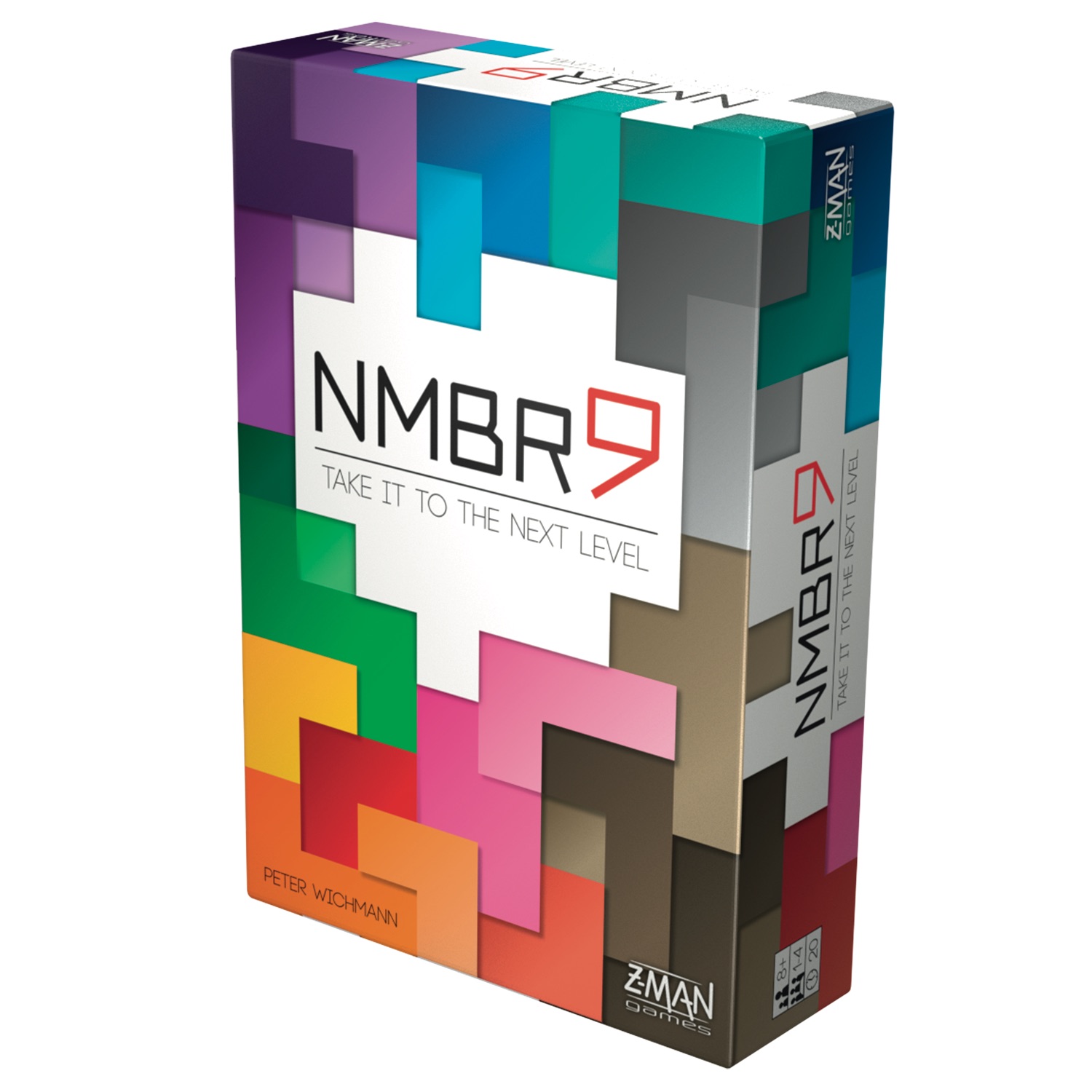
Designer: Peter Wichmann
Publisher: Z-Man
Price: £30
NMBR 9 is more of a sedate affair compared to the other games featured, and you may be wondering whether it can count as a party game when it only plays up to four players. NMBR 9 fits into the category of games categorised as ‘Multiplayer Solitaire’. This means you can combine multiple sets to increase the player count, making it ideal for larger groups that prefer quieter, puzzle-like games.
The game is very quick to set up, as you just take the lid off the box and remove the number cards (numbered 0-9). Each turn a number card is revealed, each player takes a matching tile in the shape of that number. Players must then place that tile in their play area, building up the layers for higher scores. They must touch at least one previously placed tile on the same level, and when building on the upper levels, they must be fully supported by at least two tiles below them. At the end of the game, everyone will have placed two tiles of each number, and the scores are the sum of the numbers per level, multiplied by the level they were placed on.
Initially we started playing this game on lunch breaks at work, when two people brought in copies on the same day, we had the thought to play with 8 people, and it worked really well. As everyone is playing simultaneously, the playtime isn’t affected by the number of players. At AireCon we took this idea and built on it, and have played NMBR 9 with up to 40 people at once! We’ve done this with other games such as Karuba and Draftosaurus, and it really elevates these ‘M