

A practical walk through how to work it out, using UK prices from the end of October 2026.
If you’ve turned up a stack of Pokémon cards in a loft or a childhood bedroom, the first question is nearly always the same: is any of this worth anything? Most of it won’t be. A few cards might be worth more than you’d guess. The trick is knowing what to look for before you start typing names into eBay.
This is a practical walk through how to work it out, using UK prices from the end of October 2026.
Sponsored post in partnership with UltraBall
Every Pokémon card belongs to a set, and the set does a lot of the work in deciding value. The first English set, known as Base Set, came out in 1999 and carries no set symbol at all. The expansions that followed, such as Jungle and Fossil, have a small symbol on the right-hand side just below the artwork.
Then look at the bottom right corner. You’ll find a number such as 4/102 and a rarity symbol: a circle for common, a diamond for uncommon and a star for rare. From the early sets, it’s the rares with a shiny holographic picture that tend to carry real money.
For context, here’s roughly what near-mint copies of some Base Set holos were selling for:
The Base Set Pikachu, which every child of the late nineties seems to have owned, is a common and sells for around £7.
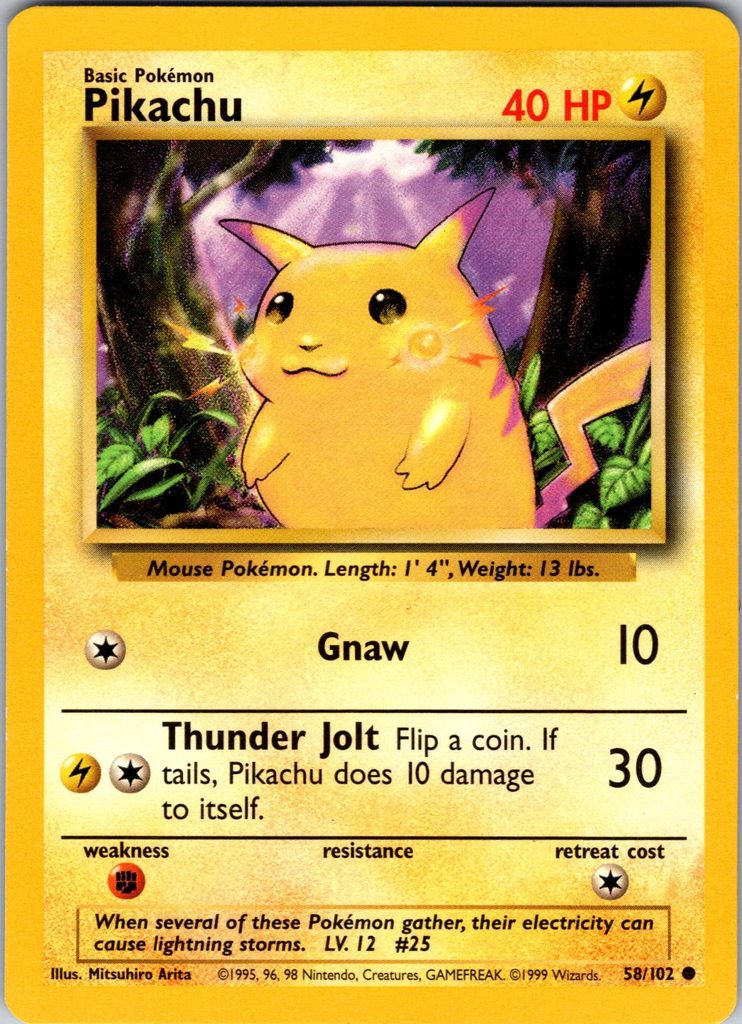
Two small details can change a card’s value dramatically.
The first is the 1st Edition stamp, a small black circle with “Edition 1” inside it, printed on the left just under the artwork. Cards from the first print run carry it, and collectors pay a large premium for them.
The second applies only to Base Set. The earliest unlimited print was missing a drop shadow along the right-hand edge of the artwork box. These shadowless cards were replaced quickly, so they’re scarcer than the standard print and priced well above it. Put one of your cards next to an ordinary Base Set card and the difference is easy to spot once you know it’s there.
This is where most people overvalue their cards. Condition runs on a rough scale from near mint through lightly played and moderately played, down to heavily played and damaged. Whitening on the edges, scratches across the holo, creases and soft corners all knock a card down a step or two.
The gap between those steps is bigger than most people expect. Taking the Base Set Charizard again, ungraded copies were selling for about:
A card that spent years in a playground pocket is worth a fraction of one that went straight into a sleeve. Look at each card under a bright light, tilt it to check the holo surface, and turn it over to see the back edges, which usually show wear first.

Anyone can list a card at any price, and plenty never sell. On eBay UK, search for the card by name and number, then switch on the “Sold items” filter. The prices shown in green are what people actually paid.
Make sure the listings you compare really match your card: same set, same number, same edition and roughly the same condition. A lot of eye-catching prices turn out to be 1st Edition or graded copies, which tells you nothing about an ordinary card.
If you’d rather not go through that card by card, a Pokémon card value checker speeds things up. UltraBall’s lets you search by name or scan a photo, and shows recent ungraded and graded prices drawn from real sales, updated daily.
Grading means sending a card to a company such as PSA, CGC or Beckett, which inspects it, gives it a score out of ten and seals it in a hard plastic case. A high grade can multiply a card’s value. A PSA 9 Base Set Charizard was selling for about £2,642, against roughly £466 for an ungraded near-mint copy.
Grading costs money and takes weeks, though, and a disappointing grade can leave you worse off than selling the card as it is. It’s usually only worth considering for cards that are already in excellent condition and valuable to begin with. For a heavily played holo or a common, the numbers rarely work.
Modern sets work differently. Almost everything in a current booster is a common or uncommon worth a few pence. The value sits in a small number of chase cards, especially the special illustration rares.
A few examples from recent sets, ungraded and near mint:
Modern prices can slip once a set has been out a while and more boxes get opened, so a card that’s worth a lot today won’t necessarily stay that way.
Before you sell or bin anything, pull out the holos and anything with a star symbol. Check those for 1st Edition stamps and missing shadows, judge their condition honestly and look up sold prices for each one. The commons can usually go back in the box. The holos deserve 10 minutes each.