
The Uno Zero card game – is it zero or hero?
Since first landing in toyshops in 1970, more than 150 million copies of Uno have been sold worldwide in more than 80 countries. It’s a simple take on traditional shedding-style card games (such as Crazy Eights), which is a great way to introduce kids to card games while still offering some fun for adults, too.
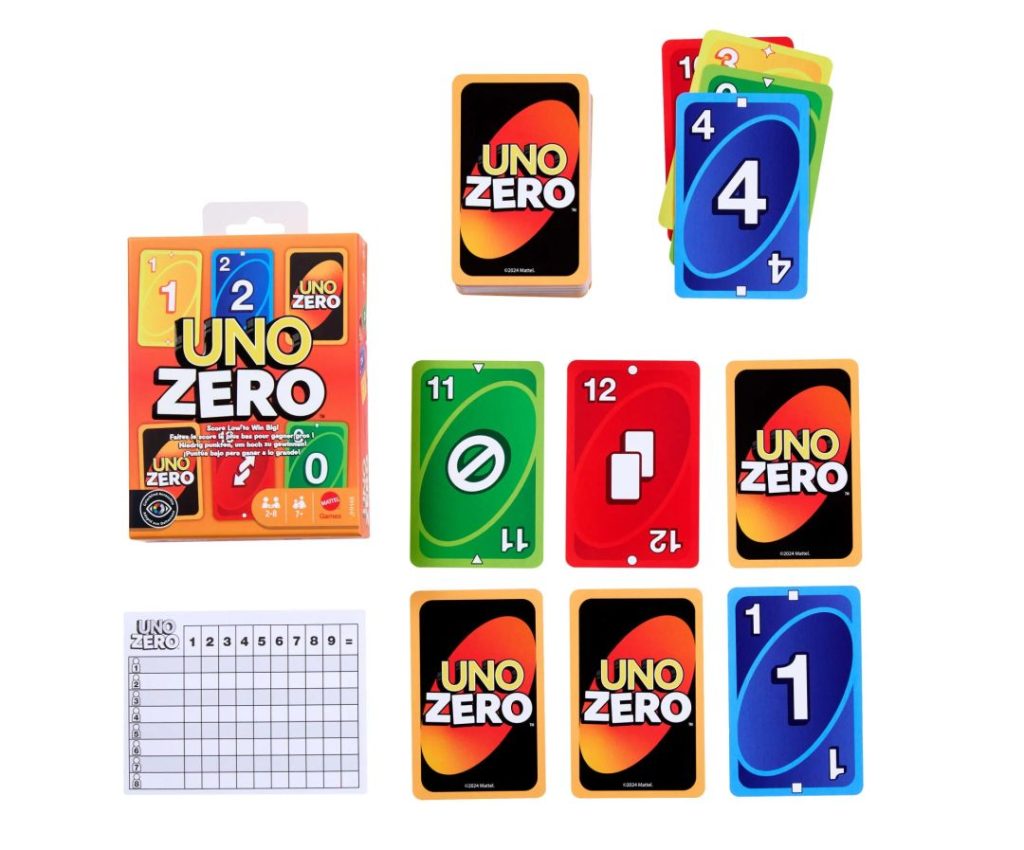
As you’d expect, Uno Zero (also known in some territories as Uno Golf) has a lot of Uno DNA burned into it, but it is different enough to warrant attention. The box has a similar set of colourful numbered cards, including several of the specials you’ll know and love/loath (depending on whether you’re giving or receiving).
Seeing as it’s a small box of mass-produced cards, the poor quality is inexcusable. No, they’re not linen finish, which makes them hard to shuffle and deal. You’re also subject to a cheap, photocopy-style rule sheet in a tiny font. Again, it’s nothing less than you’ll be used to from a mass-market card game and at least a pack is less than £15.

If you haven’t played Uno, the basic idea is that you’re dealt a hand of cards and you’re trying to get rid of them. You can follow colour and/or number to discard, with certain cards also doing nasty things to your opponents (miss a go, pick up cards, reverse the order of play, etc). When a player runs out of cards, those left in other players’ hands are given to the winner as points.
Uno Zero makes some small changes to the original concept. You’ll each be dealt eight cards (rather than seven), and instead of looking at them, you place them randomly face down on the table in a four-wide and two-deep tableau. A card is flipped over from the deck to create the starting discard pile (it must be a basic number card). Then each player randomly flips over one of their eight cards, and you’re ready to go.
On your turn, you either draw a card from the deck or take the top card of the discard pile. You then use it to replace one of the cards in your tableau – or discard it immediately (if you’re replacing a face-down card, you don’t get to look at it first). Either way, you can turn a card in your tableau face-up. If two cards in a column are both now face up and match either by colour or number, you discard them both.
As with the original, you need to shout “Uno” when you have only one face-down card remaining (if someone catches you not doing so, you draw two more cards). If you run out of cards, the round ends, and you’ll score zero, while everyone else will score the sum of their remaining cards. After nine rounds, the lowest score wins.
The only action cards included are Reverse (switch play direction), Skip (miss the next player’s turn), Draw 2 (the next player gets two face-down cards and misses their turn) and Draw 4 (the player chooses two players to draw two each, or one to draw 4, but no turns are skipped). This makes the game very easy to teach, while adding the required Uno chaos.
Uno Zero is a fun twist on the original, and if I had to choose to play one version, I’d choose this variant, as the jeopardy of the secret cards adds drama and theatre. Nine rounds feel way too long (we played five), but that’s easy to change by agreeing at the start. While I didn’t dislike it, if you don’t have children to entertain there’s not enough here to tempt a gamer to keep hold of a copy.
Written by Chris Marling
Maybe
If you’re not already a fan of Uno, nothing here elevates things in terms of depth or complexity, although I’d choose this version over the original.
Designer: Lilit Pilikian
Publisher: Mattel
Time to Play: 10-30m
Players: 2-8 Players
Age: 7+
RRP: £13
112 Cards
Scorepad
Rule sheet
Sometimes we may include links to online retailers, from which we might receive a commission if you make a purchase. Affiliate links do not influence editorial coverage and will only be used when covering relevant products