
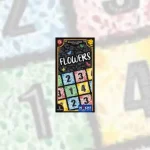
Flowers is a clever and calming game about building colourful gardens. Whilst it’s great for families and new players, with just the right mix of logic and fun, it’s not the flower we’d always pick – our reviewer delves into why.
Written by Emma Garrett
This is the kind of game I wish I’d grown up playing. It has a core simplicity that part of me wants to be bored with already because it’s so familiar. It feels like a game that could be played to death with all the family – young and old – and fill a table with nostalgia when it’s brought out years later and introduced to the next generation. If you’re early in your tabletop gaming journey, this could be just the game for you.

It’s a frustrating logical challenge based on making patterns. The ask is simple: at the end of the game, areas of colour score one point per tile, as long as they are at least five tiles big. Ideally then, you want large groups of yellows in one place, blues in another and so on. The challenge, however, is that whilst you do this colour-matching, you also need to lay your cards in appropriately sized groups of matching numbers. To be able to score, fours must be in groups of four, threes in threes, twos in pairs and the ones must not be adjacent to any other ones. Anything that doesn’t follow these rules will be removed and deducted from your score. If you needed an extra challenge to think about as you do that, you can score extra points for getting the elusive butterflies sitting next to tiles that match their colour.
As well as growing your garden out, you are allowed to place your flower tile on top of another tile to replace it. I think the concept is that you can fix any mistakes you’ve made, deal better with difficult cards, and fill in gaps to make bigger fields, but it rarely feels like an appropriate move. It’s almost never been used in the games I’ve played, but perhaps we haven’t fully grasped the nuance of the mechanic.
I’ve already spoken a bit about who I think this would appeal to. I think weirdly, for a game called Flowers, the art and cards don’t feel very flowery. They have bright, simple flowered patterns on them, but I think it’s the prominent black borders that make it feel much more abstract mathematical than nature-inspired. It’s not a problem. In fact, it probably gives you a perfect idea of what the game is like. There are some people who are instantly put off by numbers in games. They’ve convinced themselves since their school days that they can’t do maths, and don’t understand numbers. Hopefully, by theming the game around a garden, these players will give it a go and find it’s not so bad really.
There’s a reasonable amount of light strategy that offers a fun, abstract challenge without any faff or complications. As you build the fields, it tends to take up quite a bit of the table, so it’s not one you can play on the move. It’s a fine-looking game, in a nice eye-catching box. It could be about a third of the size, there’s a lot of empty space, and that annoys me. Perhaps because it takes up a reasonable amount of table space, it would be deceptive as a tiny box game.
It’s a game I would probably recommend to those playing with families. It’s not highly competitive, because everyone is working on their own garden. It’s easy to understand for younger players, as well as offering a nice challenge to everyone. The solo version comes naturally, given the only interaction in the multiplayer game is drawing from shared stacks. It’s a game with a simple concept that requires just the right amount of brain power to softly challenge the adults and engage the minds of younger puzzle solvers.
Maybe.
Logic and good planning make the highest scoring garden… but there’s a few too many niggles amidst a field of other great games. You should maybe try Festival instead.
Designer: Paul-Henri Argiot
Publisher: Actarus Editions
Time: 20 minutes
Players: 1-4
Ages: 7+
Price: £30
Sometimes we may include links to online retailers, from which we might receive a commission if you make a purchase. Affiliate links do not influence editorial coverage and will only be used when covering relevant products