

Poppycock! celebrates its premise as an anti-genius title. What that means is that it doesn’t favour those players who traditionally get all the questions right. You might have a friend or someone in your family who notoriously wins classic quiz titles like Trivial Pursuit, because they simply have all the answers stored away somewhere. Poppycock’s! […]
Poppycock! celebrates its premise as an anti-genius title. What that means is that it doesn’t favour those players who traditionally get all the questions right. You might have a friend or someone in your family who notoriously wins classic quiz titles like Trivial Pursuit, because they simply have all the answers stored away somewhere. Poppycock’s! bluffing mechanic gives players a fighting chance even when they don’t have a clue about what they are being asked.
The rules themselves take a mere five minutes to learn – a double-sided page of A4 is enough to convey all the information you need. The game initially takes the form of a pretty typical quiz title, as competitors take turns asking and answering questions. The player will secretly provide their answer before everyone else votes on whether they were correct or not. Players move forward or backwards on a scoreboard based on the response they have given and whether competitors correctly identified whether the player got the question right or not. For instance, if you assume a player got a question wrong and bet that way, you’ll find yourself moving backwards on the board if they answered correctly.
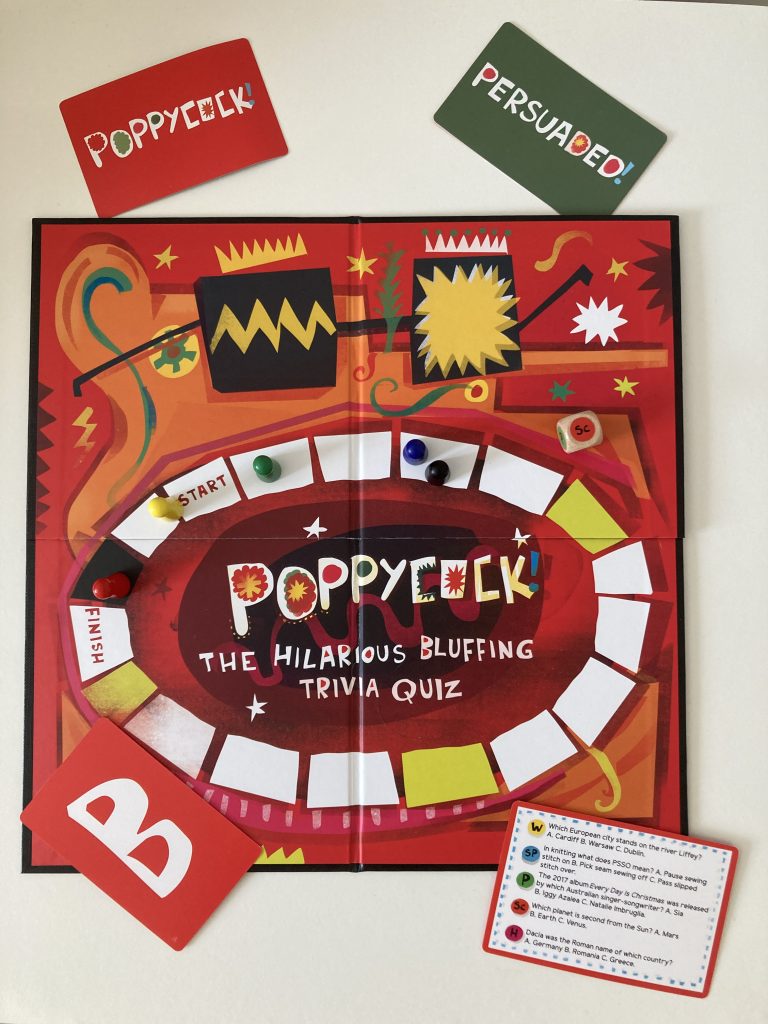
One odd thing about the game is the theme that’s been chosen for the scoreboard. This has been designed like a giant mouth and players can bet teeth on their response to the question. Why has the board been shaped like a giant mouth? If you know, I’d love to hear the answer! While the illustrations from Lee Hodges are beautiful, they are rather abstract.
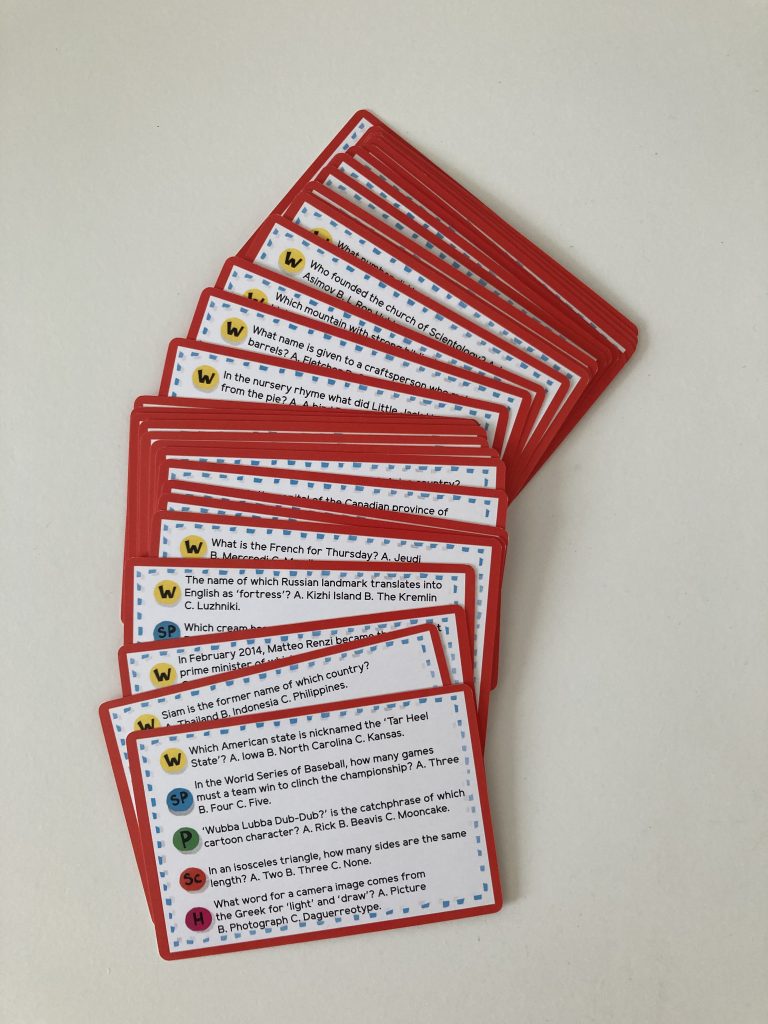
Nonetheless, a good quiz game comes down to two features: the questions and those additional mechanics designed to bring a unique dimension to play. I’ll start first with the questions, which are organised into classic categories such as World, Humanities and Popular Culture. As this is a family party game, they are designed to be accessible for all ages, without a distinct age-separation system. That means players who are 10, 40 and 80 will all be discussing the same questions, to ensure everyone is on the same page when it comes to the bluffing aspect. None of the questions were overly challenging but they were also standard fare for this kind of game, so nothing unique there.
The bluffing mechanic is where things get a little more interesting, as players vote as to whether they are persuaded by a player’s confidence in their answer. While it’s executed well enough here, it’s a familiar premise that doesn’t offer much innovation. Sadly, once you’ve played this a couple of times, the straight-forward nature of the bluffing mechanic become a little formulaic. Families are likely to get the best out of this game as an alternative to traditional quiz titles, but it lacks innovation for more dedicated gamers.
Poppycock! is entertaining up to a point, but never exceeds expectations. Also, while it’s a small detail, the poorly organised structure in the box sees cards scattered everywhere.
Review by George Chrysostomou
Maybe
Poppycock! is defined by its bluffing mechanic but doesn’t push far enough to make the concept different from other games in this genre.

Balderdash’s intelligent questions create hilarious arguments, taking bluffing to a higher level.
Category: Family & Party
Designer: Will Sorrell
Publisher: Clarendon Games
Time to Play: 30-40m
Players: 2-6 Players
Age: 10+
RRP: £20

Game board
150 Cards
6 Playing pieces
Die
Rules sheet