
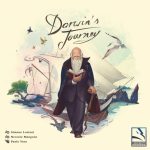
Comfortably one of the best mid-weight Eurogames Darwin’s Journey is one good iconography set short of perfection.
It’s hardly surprising that the designers behind Tzolk’in, Grand Austria Hotel, Barrage and Newton came up with an excellent Eurogame, but this might be their best yet. For starters, Darwin’s Journey is lovely to look at – as long as you’re happy with a historically themed game that has a pretty (if brown and beige) table presence. The tile and card sketches are excellent, and the map is fantastic. It’s just a shame the iconography lets things down in places, but apart from a bit of rulebook diving (I’d suggest printing your own reference sheets), it doesn’t dampen the experience beyond your first few plays.
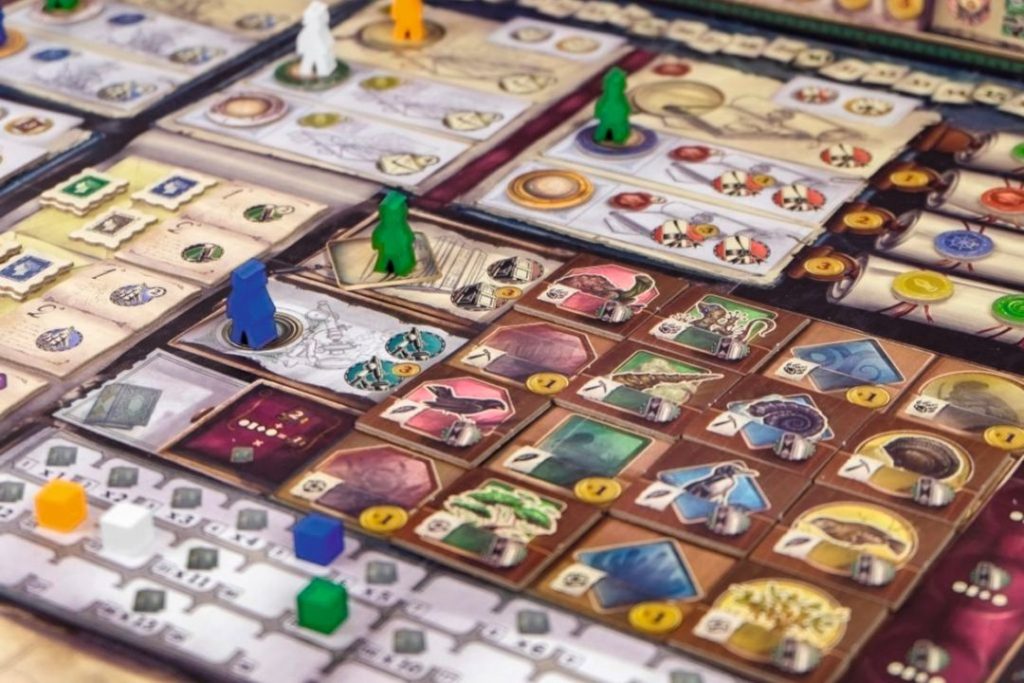
In terms of gameplay, Darwin’s Journey is an absolute joy for fans of medium-complexity games. It’s a worker-placement game, with one twist being that three of your four workers can be upgraded at your own pace. There are four main action colours, and you can improve your competency in each colour for each worker. Many actions require you to have at least one strength in their colour, with three or more strength required for the best versions of those actions.
One of the main action groups allows you to make these improvements, while the others see you corresponding (ongoing bonuses), moving your ship (largely for end-of-round bonuses) or moving your explorers (for everything from victory points and multipliers to resources/discoveries). Other non-colour-specific actions allow you to make discoveries, show them in museums, make stronger actions available, advance on the Theory of Evolution track and gain bonus tiles.
I’m aware that this all may sound – so far, so Eurogame. What’s remarkable is that every mechanism in Darwin’s Journey feels familiar yet different, either in the subtle way it works or in how it interacts as part of the whole. Sure, some of the actions may be pedestrian, but they’re usually helping you set up something epic and hugely satisfying.
For example, you may carry out an explore action allowing you to move on the island; the bonus of which is to make a camp that (as another bonus) lets you move your ship; which picks you up a discovery you need to complete a bonus tile – while setting up your camp got you another bonus on your player board allowing you to move your explorer again, giving you some resources and the chance to pick up another bonus tile. I’m smiling just thinking about it.

Aside from the aforementioned art style, the theme comes through beautifully. The game is largely mechanical, but everything makes sense thematically as you sail to islands and explore them, discover specimens, research and display them, and ultimately profit from all your hard work.
And while it may be something of a cliché, every game of Darwin’s Journey really does feel like a different puzzle thanks to the masses of setup choices available. Aspects include the special abilities of unique workers, round-end bonuses, selectable bonus tiles, strong unlockable multi-coloured actions, correspondence bonuses and specimen locations. There are also two main ways to score points (one set, the other dependent on your progress on the evolution track), alongside a wealth of scoring opportunities you can choose to specialise in or ignore.
If I could only take three Eurogames on my own long trip through the Galapagos on The Beagle, Darwin’s Journey would definitely make the list. While it may not be an evolution in and of itself, it goes to show what is possible when familiar game mechanics evolve to their highest peaks.
Review by Chris Marling
Must Play
Comfortably one of the best mid-weight Eurogames I’ve played, which is one good iconography set short of perfection.
Newton
Similar in complexity with multiple paths to ignore, master or combine, with everything knitting together beautifully and uniquely.
Buy your copy of Darwin’s Journey on Zatu
Sometimes we may include links to online retailers, from which we might receive a commission if you make a purchase. Affiliate links do not influence editorial coverage and will only be used when covering relevant products