
Words and photos by John Treadaway
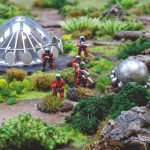
Previously, in an article you can find here, I outlined the history, rationale and terrain build for a game based on the TV show UFO from 1970 by Gerry and Silvia Anderson. This month I’ll go into the rules for a ‘lay the scenery as you go’ game for two players (and adaptable for solo play) using a SHADO team with four AFVs comprising a Command Mobile and three Combat Mobiles, each with a crew of only three but with a remote turreted automatic cannon and a mortar as weapons. The crew carry assault rifles and – for one team – a shoulder launched missile weapon.
A UFO – packed with Aliens bent on harvesting human organs from unsuspecting victims – has landed in some remote wooded location. A SHADO team have a mission to either recover the craft and it’s crew or – failing that – to kill and/or destroy them before they can abduct any more of the locals. To do this I am borrowing some ideas from Games Workshop’s Lost Patrol board game.

Firstly, I’m not going to reproduce the entire rules for Lost Patrol (LP) in full here. For a start, that might well be deemed unscrupulous. If you want a set of rules – and a set of tiles – look in your loft, garage (wherever) to see if you already have a copy, or: just go and buy a set. As an alternative, search online to see if anyone else has produced a set of rules. Er… like I did. What I am going to do is reference the GW rules and the changes I’ve made to make it work, starting with the box contents. There are thirty tiles in the GW box and that’s what I’ve reproduced – exactly – but, as I said last month, in a larger size and in 3D. There are bends, straights, ‘Y’ junctions, a dead end plus a six-way Start Tile and an End Tile: the location of the UFO and the game’s ultimate objective.

This is a two player game – SHADO and Aliens – although it can be played solo. The SHADO player has three Gun/APC Mobiles each with a Crew teams and one Command Mobile with no deployable Crew Members. The player may also have one flypast from a SKY1 aircraft, which may make a strafing run and open fire at ground targets already detected.
The SHADO player must work to locate a crashed UFO for recovery (hint: it’ll be on the last tile of the 30 tile ‘deck’) before the Aliens kill the teams and or destroy the Mobiles.

SHADO has:
The Aliens have:
Starting positions are: all four Mobiles are placed in a six way deployment Start Tile with all crew teams aboard the Mobiles (just placed on the backs of the models). However, that’s just for the initial deployment, when the game starts.


To start the game, the Aliens player places Forest Tiles randomly around the Start Tile. The Alien player begins by specifying which open path edge a new Tile is then placed on and then revealing the topmost Tile from the Tile stack. Tiles can be rotated on placement but tile rotation has to allow for an unblocked route if this possible (or as few paths must be blocked as is possible). This process is continued until all the paths that can be seen from the Start Tile are in place. If a straight path Tile is placed next to the Start Tile, the SHADO player’s unit can see right along it, so another Tile must be placed on that tile’s path edge as well. If that Tile is also a straight path, further Tiles will need to be revealed until the path turns, divides or comes to a dead-end. Once no more paths can be seen from the Start Tile, the game is ready to begin. Place the four SHADO Mobiles (henceforth ‘Mobiles’) and the three infantry teams (on their backs representing ‘em-bussed’ troops) in the Start Tile and the first Turn can commence.
Note that – although the Start Tile can handle all four mobiles (and em-bussed teams) – all other tiles are limited to a fewer number of units: this is the Tile’s ‘stack limit’. SHADO may not deliberately move more of their own Units onto a Tile than it can hold (not even to drive past each other), but sometimes they will be driven into Tiles following Abductions – refer to Overstacked Tile rule below.

As the SHADO forces move from the Start Tile in search of the UFO, the Forest is slowly revealed by the Alien player by placing additional Tiles. A Mobile or SHADO infantry team (here after just ‘Infantry’) on a Tile is assumed to be able to see along all the paths that lead from that tile to the adjoining Tile or Tiles with 360 degree vision. Upon the conclusion of a SHADO Move Action, the Alien player draws a new Tile and places it to reveal the path’s continuation: this may require two or more Tiles to be placed consecutively until the path eventually turns, divides or ends.
During Abductions the SHADO units may occasionally be knocked-back onto a Tile with an unobstructed path. The Alien player then is required to draw additional Tiles and places them to continue the path until it is once again obstructed (as if in the ‘Forest Builds’ Phase 2).
The Forest is an uncharted wilderness and occasionally it may grow into a loop from which the SHADO units cannot escape no matter what they do. This means the SHADO units will not be able to reach the UFO and the SHADO Player forfeits the game. Another batch of Aliens escape with more human captives!

The UFO tile is the last Tile in the stack. Once this is placed on the table, then no further Tiles can be placed. In this game, tile are not removed but stay on the table.
Play proceeds Turn-by-Turn until a SHADO unit locates the UFO; or all SHADO units are lost or killed. Each Turn consists of five phases, resolved in the following sequence:

During the SHADO units Action Phase, each SHADO unit may make a total of two consecutive Actions: either Fire or Move. This is called its ‘Activation’. As there are three different unit types they may proceed in the following unique ways:
Resolve each SHADO units Activations one at a time, completing all actions of a unit (Infantry or Mobile) before moving onto the next unit.
In Phase 1 a single Move action progresses a Mobile or Infantry onto a tile adjacent to their current tile, following the path. By expending two Move actions a Mobile (not an Infantry unit) can move two tile spaces. A Unit cannot move off the Forest paths, neither into the Forest nor off the tiles. In the event that a Move Action reveals an unobstructed path, the Alien player draws additional Tiles in Phase 2 and places them to continue the path until it is once again obstructed.
SHADO units can move onto Tiles containing Aliens, or past them irrespective of stacking limits. SHADO infantry can – in their own ‘activation’ – hop on and off a Mobile at no cost (in terms of Actions). This means that they may de-buss; shoot twice and get back into a vehicle on the same tile all in their own activation part of the phase.

Sometime the Forest paths are blocked by fallen trees – these are deemed ‘Heavy Going’ (they would be ‘Tangle Weed’ on the LP tiles). While SHADO Mobiles can move onto Heavy Going Tile with no issue, attempting to move off of one requires a check to see whether the vehicle is stuck. Bowl a d6. 1,2 or 3 and they are stuck and their Move Action wasted. Stuck SHADO Mobile units can expend further Actions in an attempt to escape the tile. SHADO infantry, however, can ignore these obstructions and treat them as a regular tile. They also have no effect on Shooting, Line-of-Sight, Abductions nor Alien movement.
Mobiles and Infantry can shoot at any Aliens they can see (and – with Mortars – even if they cannot see them). Each shot uses an Action. Each Unit type fires with different effects – the Gun Mobiles have two options.
Standard Gun Mobiles
These have three functions. They transport infantry teams (hopping on and off to extend their movement) but they can also fire either their cannon or their mortar (but not both in the same turn). They can also give covering fire and are better at resisting abduction attempts (the Aliens have to force the doors open…).

Command Mobile
This vehicle is specialised in what it can do.
Infantry Teams.
These can fire with only side arms:

SKY1
A SHADO unit can shoot at Aliens and Escape Pods in their unobstructed, line-of-sight, expending one action to do so. Each time a SHADO unit achieves a hit an Alien (or the Escape Pod) is removed (Alien player’s choice) and that figure is put back into the ‘pool’ – who knows how many are out there! The forest is swarming with them…
Tiles must be placed that can be seen by the SHADO players and must not be placed to block where this can be avoided: if there are two choices as to which way they can go and one blocks a path, chose the other way. If playing solo, and a an option materialises that needs a decision, just roll a dice. The Forest’s paths are convoluted but – unlike in the LP game – they stay where they were left: this is Canada, not an Alien planet… Once the tiles are laid they stay down.

During the Alien actions part of each turn, the Alien player must take four actions. These can be any mix of actions desired by the Alien player; however, a Alien cannot forfeit any of their four Actions.
You might notice that – unlike in LP – there is now a rule providing the means for Aliens to shoot at the SHADO units from adjacent tiles only: although they can shoot at them, their ambition is to carry away human bodies for organ transplants!
Optional Rule: an extra Alien Action
For each Action used, put a single Alien Figure at the end of a path, or place an Escape Pod. Each of these will cost an action however the pod will then ‘generate’ extra Aliens at no cost: see below.
Escape Pods may be ejected from the mother UFO and may land anywhere in the forest. Only one of these can be on the table at any time. This placement costs one Action but costs no further actions as long as it is in play. An Alien player designates any Tile and rolls a dice. Out pop a number of Aliens equal to a modified dice roll: in the first turn it is that 1d6 of Aliens but minus 1 Alien for the total number of SHADO units in adjacent tiles (including the tile it is placed on). Example: if a pod is dropped next to a Mobile which also has an infantry unit in the rear, that’s two SHADO units, so it rolls 1D6-2 Aliens in it’s first Phase 3 when it is placed. Each subsequent Phase 3, in each turn after that the Escape Pod is in place, this total is reduced by one so the following turn it would be 1D6-3 (unless the SHADO units move away). On that basis, eventually the pod will be empty of Aliens. I keep a track of this with a series of six counters placed next to the model, one for each turn. This is a way of getting Aliens in closer to the SHADO units as they don’t need to be placed at the end of a path and remember that – once placed – they do not cost an action to roll the dice to get more Aliens! If the SHADO team destroy the pod the ALIENS may then launch another but not until the first one is destroyed: two pods may not be on the table at the same time.
Unlike SHADO units, Aliens need not follow the forest paths but – at the cost of one Action – are able to move from their current Tile onto any adjacent Tile (though not through empty ‘voids’ where no tiles have been placed. They can move as a group from one tile to another (one action for each tile for the group) or may separate up (one action for each Alien/tile movement). While moving to attack for an abduction, they can temporarily ignore stacking limits. This means that, for example, six or eight Aliens can attack a SHADO unit on a tile if they can organise that kind of ‘pile on’.
Aliens may shoot into any adjacent tile. Multiple Aliens get multiple dice but each ‘volley’ of shots costs just one Action. So – if four Aliens fired into a tile with a SHADO unit – for one Action expended they would get four d6. Shooting into an adjacent hex gets hits on a 6 but against SHADO infantry only. Their shots bounce off the Mobiles. Shooting takes place in the Alien Actions Phase 3 before Abduction attempts.
Once the Alien has finished their Actions (creation, movement and/or shooting), any left on the same Tile as a SHADO unit can attempt to overpower and Abduct some humans. This is entirely up to the Alien player: they don’t have to Abduct but may choose to hide in the undergrowth if desired. Aliens can also attempt to Abduct any SHADO unit that has been driven back into a Tile already containing an Alien; however, multiple Aliens can still only make one Abduction attempt per Turn. They abduct Infantry and Mobiles with equanimity: they break into the vehicles and abduct the crews…
The Alien players adds up the number of Aliens attempting to abduct and the SHADO player rolls dice to determine an Abduction’s outcome.
Score:
Each Alien counts on the tile as a score of 2.
Against that, the SHADO units roll 2D6, regardless of the number of units – Mobiles or infantry – present.
However, add up any circumstantial bonuses…
So – potentially – that’s a maximum of Plus 4 to add to 2D6.
Results:
Heavy going does not inhibit a model being driven back: a SHADO unit does not make checks when being driven out of a tile which is so blocked. Driven back Aliens and SHADO units need not remain together. Example: if a single Mobile was successful in defeating 3 Aliens in an abduction attempt, 1 Alien would be eliminated whilst the remaining 2 could be moved into the same or different Tiles, adjacent to the Tile in which the attempted Abduction took place. Placement can be important as it can be used to force an Overstack or to push targets into better firing lines, or even into further Abduction spots.
The Start Tile is especially large and has room for all SHADO units (with the Infantry in the four Mobiles) and Aliens. All other tiles are limited to fewer units. This is the Tile’s Stack Limit.
Regular tiles are limited to:
plus
Sometimes Units will be driven into Tiles following Abduction attempts and this can result in tiles becoming Overstacked. If, at the end of Phases 5, a Tile is determined as ‘Overstacked’ (with – say 3 or 4 Mobiles) excess Units are removed: they lose vehicles or infantry (as is the SHADO player’s choice) so maybe a Mobile reversed into a ditch and is stuck forever or perhaps the infantry fell into a lake or were just captured and abducted by Aliens lurking in the woods… Each player can choose which of their own Units that are lost.
Any Aliens (or the Escape Pod) that are forced to overstack have been shot or driven off. However, they aren’t dead and they go back in the pile.
Note that a tile that contains, for example, 2 Mobiles, 2 Infantry (the maximum) plus 4 Aliens is not over stacked… The Aliens are hiding in the trees ready to pounce

The last tile is the one with the UFO on it. When the SHADO players see it they may drive for it. The Alien player can’t generate any Aliens from it as it’s in a dead end (and they’re all out hunting victims) so – in that last turn – there will be a rush: how many units can SHADO get onto the UFO tile? The maximum would be four – two Mobiles with two infantry or one Mobile and three infantry. If the SKY1 runs haven’t all been used up (and you have a command mobile present somewhere on the table and with an Action to spare) you might try to call in a SKY1 run as well). So the SHADO player might have a possible maximum of five D6 (on a lucky day) if SKY1 also turns up. They are all rolled, but only the best score is noted and – against that – the Alien player rolls only one dice: the highest individual dice score (not the total) is determined and the following applied:
Tile placement
Commands
Aliens
This makes for a fast paced game that lasts about an hour. There’s a reasonable chance that the SHADO team will win if you use the four alien action option. If you chose the five alien action mode, it can be a very closely run thing: SHADO will certainly need luck and planning to stop the Alien menace… It can be played with printed vehicles and counters for the figures using the tiles in the GW game box, or you can build tiles and play in 15mm like I did or go 28mm and make me very jealous!
Many thanks are due to all of the play testers and help I received plus the material support from companies who helped me realise this.
Rules download or original Lost Patrol game
Original UFO Games by my group
3D models if you have a printer– (search for “UFO TV series”)

Find reviews, news, and features in Tabletop Gaming Magazine, which is home to all of the latest and greatest tabletop goodness. Whether you’re a board gamer, card gamer, wargamer, RPG player or all of the above, find your copy here.

A game that hooked a thousand gamers, it’s 40 years of Fighting Fantasy! We take a look back at some of the titles and that changed a generation of gaming, and how it became the behemoth it remains.

Be the first to hear about the things we’re excited about, whether that’s new games and launches, our own magazine, gaming news and interviews or a few surprises, you’ll be the first we tell if you sign up to our newsletter.

Have you visited our game store? We have everything from mystery boxes, to games and accessories, so you’re bound to find your newest favourite. Head over there now to claim it for yourself!
Sometimes we may include links to online retailers, from which we might receive a commission if you make a purchase. Affiliate links do not influence editorial coverage and will only be used when covering relevant products