
Talking piles of shame, asmodee acquisitions (but not buying his fave game!) and inviting a superhero to dinner!
It’s been 18 months since asmodee announced its split from Embracer and became a separate entity, and it’s been over a year since Thomas Koegler became the CEO of asmodee. Tabletop Gaming editor Matt Chapman caught up with him at Lucca Comics & Games to ask what’s changed during that time, and what’s stayed the same?
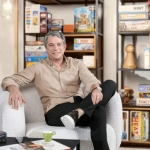
“What has not changed is our strategy,” says CEO Thomas Koegler, wearing a cream asmodee hoodie with the company’s rainbow logo that we later Google to see if we can buy. “We’ve been building that strategy for 10 years and we will be continuing it for the foreseeable future. The one thing that changed is that when you’re part of a group, sometimes you benefit from it, sometimes you contribute a bit more. In the latter years of us being part of Embracer, we did contribute a bit more, because there were struggles on the video game side, which led to us putting one of our growth engines, which is acquisitions, on hold. The biggest change is now we are an independently listed company, so it’s a different way of operating – not for the teams on a day-to-day basis, but as a group. It’s effectively being able to be back walking on two legs, which we were missing a bit.”
It’s serving the local markets and continuing to be successful with the brands that we have, that’s the number one priority. And the number two is bringing new teams or new brands and IPs into the asmodee world.
We grow both ways.
It’s the project, and the project can be a variety of different projects. Sometimes it’s specific IPs that we love and that we would like to see thrive within Asmodee. Acquiring Zombicide is a good example of that. Because we like the game mechanic, we think we can do something with the game mechanic, because we like the zombie universe, and we can continue to build experiences. Because we like, in that specific case, the crowdfunding part that we haven’t done at asmodee. That enables you to explore creating specific experiences that would not have the same chances and would not exist if they had to go through traditional publishing and retail.
Then sometimes it’s the teams. It’s people we believe in who we feel have something different, that’s often what you see with younger teams. Because look at us, we’re outdated for certain younger audiences who discover things on TikTok or will buy things in patterns that are completely different from what we do. And so sometimes bringing in young talent means you’re more connected with younger audiences.
Well, the strategy of asmodee is to have first a broad portfolio, but also a portfolio where you give the opportunity to each and every one to succeed. Nobody knows what will be the successes of tomorrow. And those that pretend to are a bit cocky, I would say. So it’s a mix for the studios. First of all, we preserve their DNA. A game made by Days of Wonder is not the same type of game as one made by Libellud or Fantasy Flight Games, right? They have a specific eye and a specific approach.
They might share some resources. Yes, we did centralise supply chain manufacturing so that the teams can really focus on the creativity part. Then it’s a balance between creativity, inventing new things, creating new IPs, etc, but also brand building and continuing to build experiences and ranges in a given universe. What has been great within asmodee, for instance, is Ticket to Ride has expanded and brought in new experiences. The city versions, with My First Journey, with Rails and Sails in terms of complexity, or even Legends of the West in terms of legacy. The same for Seven Wonders. You start to build different entry points or different experiences within one universe.
So the experience in brand building is one side, and the other side for the studios is the pure creativity that leads to having games in recent years like Harmonies, Lego Monkey Palace, Brick Like This, Star Wars Unlimited or Take Time – which is coming out now and is quite innovative. That’s the environment that we want to offer, an environment where creative people can thrive.
It’s something we are offering. Sometimes there are moves between studios, depending on the centre of interest. We have people that moved from France to South Korea because it was their personal project. It’s offering the conditions, and then it has to come from the people, because our role is not to move people like pawns. It’s to have people that show what they’re interested in, and then we can help them be in the place where they will thrive.

There are several layers to this new branding. The starting point was that asmodee was a boring, corporate brand that only communicated when we were buying companies or when asmodee was sold. This led to some people having the impression that asmodee is a financial institution that is gobbling up other companies and just piling up activities. It’s really not the case. I mean, we are players from the warehouse to the CEO. I’m a very big gamer, my leadership team are all gamers. Yes, we have serious corporate jobs. But the Inspired by Players mindset is that first we are players – we live and breathe the passion of what we do.
The second is that we would like asmodee to become a seal of quality. The expert consumers will always relate to the game brands and to the studios. And we do not aim at erasing the studios and replacing them with asmodee. That’s absolutely not the point, because, as I said, a Days of Wonder game is very specific, a Space Cowboys game is different, and we want to keep this. But some more mainstream consumers are less educated. If you go into a mass-market store anywhere in the world with a game aisle, you have players that know what they want, they grab the game and they leave. Then you have those that don’t know, and they walk up and down the aisle for 20 minutes not really knowing, and then they pick. We think that asmodee, because of the breadth of the portfolio that we have – both from our own studios but also from the partners we distribute – could bring some organisation and category management, with the objective of helping people play and discover more games. That’s the idea behind Inspired by Players.
As I said before, people see us as a financially driven company. Of course, we’re ambitious, we want to build, because we are a business, not a non-profit. But every single day, the decisions we make are for the market and for the players. Again, I come back to Inspired by Players. We are players. The biggest misconception is that at corporate level, we are distant from the business. It’s absolutely not the case. Our Chief Commercial Officer plays Magic: The Gathering and Star Wars Unlimited, alongside so many games. We all have 100 of games. It’s a lot of shelving and a high pile of shame.
Well, it’s still a booming market. We like to look at the world in two big types of games: trading card games on one side, board games on the other side. Those saw different dynamics.
Board games really exploded at the beginning of the pandemic when games breeched into places where they were not, or not enough. Families, young people that use games to socialise, etc, once it had it entered, it is there to stay. Maybe the practice slows down or intensifies, but in the end, this is a glass ceiling that was broken and brought the industry to another level.
Trading card games are very hot currently, of course, because more and more people are interested in them, because I think there are some great IPs that provide fantastic experiences. I mean, Pokémon has been leading the way with Magic: The Gathering for the past 30 years in two different ways, and they have both been able to expand the audiences. Then with new IPs coming, we have Star Wars Unlimited, One Piece, Riftbound is arriving, Gundam has been released. You have a certain number of things that really talk to different audiences. And so what we saw is an expansion of the TCG audience, rather than a cannibalisation between the various audiences. After that, TCGs are cyclical.
Nobody can say what will happen when. Our role is to accompany the industry and the players and the shops. The players, the shops, the publishers, the distributors or groups like us are the ecosystem with the authors and the game designers that makes the success of this industry.
It’s not a rationalisation. I think that we had a certain number of initiatives in various studios, but there is a know how into making a game accessible to children. I’m not talking about games exclusively for children that you can see in other brands. Here, it’s about games where we want kids to be able to play with other kids, but also parents to have a good time playing with their kids. Some kids’ games are boring when you’re a parent. Here it’s your introduction to the next steps. And that’s how you have Ticket to Ride: My First Journey, Mysterium Kids, Unlock Kids, Catan Junior. And the idea is to put them under an umbrella called asmodee Kids, so that we have experts that can work with the original studios in crafting experiences which will be a great entry point for kids in the universe, that hopefully then they will start playing the base game and evolve. So it’s not a rationalisation. I think it’s more a combination of forces to make even more games accessible to kids.
They are extremely important. We still have a lot of plans with major IPs, because they enable you to reach certain audiences. It provides an excuse to enter into playing games for some audiences. It’s an acceleration, a way of bringing people that might engage with an IP or with a universe principally through movies or TV shows or video games into the world of playing board games, because maybe someone that enters with a Lord of the Rings game in Seven Wonders Duel from instance, will then play Seven Wonders, will then play Ticket to Ride.
So it’s an entry point, but it’s not at the expense of creating original IPs or continuing to grow the original IPs that come from board games, We want to continue to bring things like Take Time or Harmonies or Heat, all those recent successes or expected upcoming successes, alongside Ticket to Ride, Catan, The Werewolves of Millers Hollow, that start to make the journey the other way around, growing outside of board games to become video games or TV shows, movies, etc. And it’s starting to become a two-way street, where it was a one-way street.
We have licencing teams and their mission is to try and find the best possible partners to do these first exploratory journeys outside of tabletop gaming. But the objective is not to run licencing shows and just hand over licences to get whatever experience, because we don’t want it to be disappointing for consumers. And so the objective is to find the right partners, to find the right project that will really meet those objectives.
There are two objectives, which I can illustrate with The Werewolves of Millers Hollow. You had the Netflix movie, which was a very French humour movie, but the objective of the movie was not to talk to the core audience of Werewolves. It was to help people that do not know Werewolves discover Werewolves through a movie. And the greatest feedback you can receive is, ‘Now I know about the IP and the game, I want to try the game.’ But for the super core fans of Werewolves, it’s not a movie for them. The real experience for them is the TV show, which was on Canal+ and now is in Germany and will be in 10 new countries. This really provides the experience for the core fan base. So that’s the two types of partnerships that are successful that we’re looking forward to.
I started from the video game and watched the TV show. There are TV shows I’ve watched and then read the book. So again, it goes both ways. And we shouldn’t be elitist and isolating, we should embrace the fact that every way – as long as it’s a quality experience – is a good way of bringing people into our universes.
The starting point is to facilitate access for people to discover and learn games, and play some games if they don’t have the people around them. Of course, it’s a nice source of revenue and profits, but the first mission is to create the occasion for people to play more games. So it’s an add on, a different way of experiencing games. What you see is that people discover games on BGA and then very often they buy those games in a physical shop. Because it’s great to play online, but they also want to play with friends and share the joy of playing a game.
We will see. I think that if technology is at the service of the experience and enhances the experience, there are great things to be done. It’s not there to replace the experience. But hopefully technology will help solve the most difficult part, which is what happens between the moment you open the box and the moment you play your first game – the onboarding, the learning. And some people will want to have enhancement, such as AR or aids for Game Masters in RPGs. But again, it’s the choice of the person, so it will not be imposed. It should be an enhancement.
It’s one of the fundamental basics of our success in this industry. People need to discover games. You need to be on the field and demonstrate the games, enable shops to run gaming nights or to run pre-release events. That’s why we set up programmes like Hobby Next, for instance. The hobby shops are the heart of our industry. Yes, of course, a lot of things happen in the mass market and online, but you cannot replace the experience that the hobby shop provides. So it’s something we invest in and something we will continue to invest in.
When you do studies, people buy games because they’ve been exposed to the game one way or another. They’ve played it or it’s been recommended by someone they trust. And this does require organised play, it does require demos and it does require empowering shops to run those.
It goes both ways. If you go to Spiele, you have tables of Ticket to Ride. If you to Gen Con, you have a booth for Catan. That’s something that’s very important, our industry is not just about novelties. Sometimes we collectively put too much focus on the novelties. The problem is that a novelty chases another novelty and pushes it out. And a lot of the market is done by the long sellers, because they are good experiences and they are often a gateway for people to become new players. And we should cherish and continue building on those, and alongside it promote and build the novelties, because the innovation is there.
But it’s not one of the other. And, in my opinion, for a store to be sustainable in the long term, they really need to have those two mindsets. I am growing my community. I am working on the long sellers, on the engagement, and I’m also pushing the novelties and helping them navigate the novelties.
My favourite game is Blood Rage, which does not belong to asmodee by the way.
It was just sold to somebody else, so not for the foreseeable future. But in business, you have to make choices.
Right now, I’m pretty fond of Henry Cavill. He has made some heavy games quite cool to play. I’m not in the American culture, where you have a lot of people like Vin Diesel, etc, that play RPGs and Dungeons & Dragons, but he has great taste in miniatures games. Games Workshop is a fantastic company, Warhammer and 40k are fantastic games, but it contributes to making our hobby or our industry more socially acceptable and positive. So I think it’s good to have people show their nerdy side in front of the world. Plus, he’s Superman!