
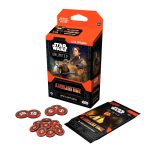
asmodee CEO Thomas Koegler discusses the explosive growth of trading card games, Star Wars Unlimited, Pokémon, Magic: The Gathering and the future of tabletop gaming in this exclusive interview
As we greet Thomas Koegler outside Hall 3 of UK Games Expo, since we lack the requisite hi-vis clothing to enter the hall while the build is still happening, he’s talking about a game of Uno he played last night with some interesting homebrew rules. “For each colour, you have to do something. Like when it’s blue, then you need to whisper. When it’s red, you need to talk in singing like you’re in a musical. When it’s yellow, you need to talk with an accent and when it’s green, you need to change the pitch of your voice,” the asmodee CEO explains. “You end up drawing a lot of cards, because you don’t pay attention. My friend knows the rules, so it’s tailored for him to win – and he did. But it was still a lot of fun.”
His discussion of cards is apt, since we’re here to take the pulse of the trading card game (TCG) industry, in which asmodee is a major player.

We’re going to talk very much about trading card games today and obviously that’s a big deal for asmodee. However, the first question is more personal: do you have a favourite TCG?
Thomas Koegler: I do. It’s with us, it’s Star Wars Unlimited, because I’m a big Star Wars fan, first. And second, the game is quite accessible. I have a history with Magic: The Gathering when I was a kid, but that’s a long time ago.
We’ve seen new trading card games make a big noise in the space, including the biggest tabletop Kickstarter ever. How many TCGs can the gaming market support?
I don’t think there is a definite answer to this. What I mean by that is it’s twofold. The first thing is that since 2020-2022, I think trading cards have become socially acceptable for way more people that might have not considered collecting cards. So this owning, trading, etc. is something with much more of a broad appeal. And the second thing is the fact that the TCGs that are around and the new ones, they all come with very strong IPs and with fans of those universes, and so that’s why there is some overlap, for sure. But I think that every time there is a new TCG coming out, there is also, in a certain way, an extension of the audience, and so that’s why I would say it’s not a zero-sum game, I think it does expand. What we’ve seen with Lorcana is that it has brought in people that have never looked at a TCG, while Star Wars Unlimited is more gamer-oriented but is still bringing in fans. One Piece, Riftbound with League of Legends – it does bring people into the hobby that would have probably never considered it before.
Is that new acceptability one of the reasons that TCGs are thriving?
I think there is a bit of this. I do not believe that actually the financial returns that some believe or the financial play is the main driver. I think it does exist, but it’s ancillary, because in the end you want to have people owning those in the long term for it to work. This is something I don’t like, but I don’t think it’s a big problem in the end, apart from the fact that they snatch cards and products from people that would like to have them for their own benefit. So the topic is more on accessibility, getting access to products. And probably also in referring to the previous question, the trade-off of limited cash that store owners have, and there might be a limit of how many TCGs a store owner can operate in tandem, that there might be a bottleneck there.
Anytime there is success, some people will point to it and say that it’s a bubble. Is the success of the TCG market a bubble, or is it sustainable?
I don’t think so. Nobody has a crystal ball, of course, but I think we are now in an era that’s very different from what was in the past, and there are two things here. I think people talked about a bubble, but it was on expert TCGs that were really appealing to players. Then there was competition, and maybe you had fiercer competition. On the collectability side, I think that all the IP owners do a remarkable job of constant product release. I think they are much more cautious than they might have been in the past in terms of increasing the volumes to an unsustainable level. So I think it’s much more contained or managed growth, in a certain way.
I talked about the extension of audiences, and I think that Pokémon used to be very cyclical when it was a kids’ franchise, prior to 2020 or 2019. Then the seeds that were planted with Pokémon Go flourished during the pandemic, re-engaging lapsed audiences to the Pokémon franchise. Now you have less direct competition from collectible cards, like sports cards when there is a World Cup, that did bring huge swings, or the back-to-school phenomena and the competition those brought. So I think we’re in a different era and I don’t personally see it going away. Will there be ups and downs? Yes, of course, because it’s the nature of doing business, but I don’t think in the magnitude that has been experienced in the past.
Are we seeing players embrace more than one game today? Is there a Venn diagram that contains Star Wars Unlimited, Magic: The Gathering and Lorcana players?
That’s a difficult question, because being a TCG fan is highly committing, both in terms of time, energy and money. So I would like to think so effectively, but beyond one game is already is good, two games is a lot and beyond that I think it’s a bit of a stretch. That would be my personal observation.
And what’s the mix today of competition versus collecting, because collecting has become such a big part of TCGs?
It depends on the game. I think it’s something that varies tremendously from game to game. The one thing I would say is that the TCGs that have a long-lasting life are the ones that do both well, which is I don’t think you can do only collection or target collectors, because then it’s flickering. So those that have built long-term success built both, but it’s impossible to measure what is collection and what is gameplay.
And how important are local game stores to the future of TCGs?
They’re immensely important because they are the heart of the communities, and they do so much more than just making products available. They do two things that I think are fundamental for the collector, for the players, for the fans. The first is they enable discovery by the gaming nights, by the Friday Night Magic, by all the organised play, the pre-release events. All of this is contributing to the community engagement in those games, which is what publishers want, and which is the long-term success. And then the secondary reason is that I think that it’s profitable for them, and I think that then they can also have some secondary single cards business that is also interesting. And I think when the secondary market is healthy and balanced, then it means that you’re in a good spot for the longevity of the brand.
You talked a little bit about how IPs bring people into a game. Is it still possible today to create your own IP for a card game, or do you have to attach it to an existing IP?
It’s a difficult question. I think right now, the environment you need for a card game to work, you need to have an innovation in a certain way. And the innovation can be bringing a card game that is in a universe that was not served up until then. Or if it’s more of a generic universe, then you need to have a very strong innovation, either in experience, game play, etc.

We’ve just seen the largest ever tabletop crowdfunding campaign and that was for a TCG. Is crowdfunding a sustainable model, or do you need to move to retail?
I think you need to move to retail. As I mentioned on the importance of retail, especially independent and hobby retail, if you want to keep the community alive, they need to have a place to play, they need to have a place to engage, to trade, to discover, to do all of this. The gaming part is very important for the longevity of the TCG, otherwise it’s mainly collection and ownership. So it will be interesting to see how Cyberpunk evolves from the Kickstarter on. They can be inspired by projects like Zombicide, for instance, or others that were successful on Kickstarter, and then successful for retailers. Where you need to be careful is that the hobby retailers also need to find an interest for themselves in carrying the line, so if the bulk of the sales are gone, you take a risk. The long-lasting partnership with hobby retail, in my opinion, brings long-term value. So it’s tremendous success and they can be super proud. If they want to be long lasting, they have an interesting step to take and to be successful at for it to work.
Is there a recent game that’s impressed you – either from a design or a business point of view?
I think that some recent TCGs have really brought an upgrade of what can be done with cards in the way they look. Because the gameplay, etc. has been demonstrated by many TCGs, how robust they can be. The balance between card rarity and their appeal, etc, this is known. It’s not a science, so you still need to figure it out. I think that the latest innovations on the cards, on the foils, on all of this have increased also the ownership appeal of some cards, and I think that One Piece is quite fantastic at this and also Riftbound raised the bar on how the cards look.
What trends in the TCG industry are people overlooking right now?
I wouldn’t say overlooking, I think the one everybody should think about is how can we make these games even more appealing to consumers, thanks to digital and technology, because there is always the component of, do I have people around me to be able to play. I also do think that TCGs in the building of the deck, it is a complex science. There are masters of it. There are so many people that are eager to understand it better. When I say technology, it’s in the sense of getting access to the information. I think that a lot of streamers and reviewers are doing a fantastic job at this. So not just be focused on buying stuff, but really thinking how can I educate myself on being even better at the game is something that is important.
And the second one, and the biggest thing I think everybody needs to work on, is how do we make the game accessible to new players? The onboarding is the biggest challenge we all face, and it’s not just on TCGs, and I think some innovation there could make our industry even more important in the world.
Interview by Matt Chapman
Sometimes we may include links to online retailers, from which we might receive a commission if you make a purchase. Affiliate links do not influence editorial coverage and will only be used when covering relevant products