

Sprawlopolis is a card game modern classic from the publisher Button Shy, one of their most popular tabletop games, and one which is instantly recognisable. Rob Burman takes a deeper dive into the city Sprawlopolis builds with two of its designers.
Interview by Rob Burman
Have you ever thought you could become a city planner? Perhaps you’ve walked round your local area and thought ‘there really aren’t enough industrial areas next to parks’ or ‘this neighbourhood really needs a motorway straight through the middle’. Well, hate to break it to you, but those ideas stink. You really need to commit these planning atrocities in the safety of a tabletop game… and Sprawlopolis is just the ticket for you!

Hailing from wallet game publisher Button Shy, Sprawlopolis was created in 2018 by a Triforce of designers: Steven Aramini, Danny Devine and Paul Kluka. It has arguably become one of Button Shy’s most popular games, with numerous expansions and an ever-growing list of follow-ups (Agropolis, Naturopolis and the recently Kickstarted Casinopolis). To find out more about the creation of the Opolis series, we caught up with creators Steven and Danny.
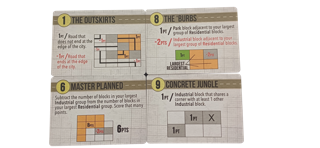
However, before we get onto the interview, let’s take a quick look at how Sprawlopolis plays. Like all of Button Shy’s releases, Sprawlopolis has just 18 cards that you use to play. On one side is an illustration of a city area consisting of four districts, which are split into four different types: commercial (blue), park (green), industrial (grey) and residential (orange). Meanwhile, the reverse shows an objective you must try to complete, e.g. one point for each park area in the interior of the city or two points for each industrial block next to a commercial or industrial block. Finally, in the top left of each objective card is a target number.
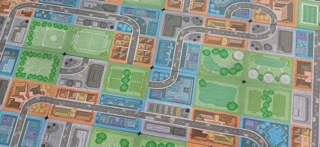
At the start of the game, you’ll randomly choose three of these objectives, add up the target numbers and this becomes the score you must beat in order to win the game. You do this by carefully placing cards either next to each other, or even on top of a previously placed card, to (hopefully) create the best combination. Of course, it can be an extremely difficult task to maximise your points and part of the beauty of Sprawlopolis is the agony of choosing which objectives to pursue because some simply don’t complement each other. Perhaps what’s most impressive about Sprawlopolis though, is the sheer amount of replayability from just 18 cards because there are a total of 816 possible combinations to complete! Even more impressive is the fact that Boardgamegeek user Lars Toft actually played all 816 combinations (with a win rate of 73.28%) throughout 2020.
What’s unusual about Sprawlopolis is that it didn’t start life as a city builder – instead you were building a pyramid. Steven, Danny and Paul had just created Circle the Wagons for Button Shy and were looking for their next project and, although it had some comparisons to Sprawlopolis, the end result was something very different.
“You started out with four sections at the bottom of the pyramid and had to build up from there,” explained Danny. “Although it was a fun game – and Button Shy owner Jason Tagmire is still thinking of a way to release it – we found that the pyramid structure was a little too restrictive. So, we asked Jason if he had any ideas about how to improve it. The feedback from Jason was pretty specific, he wanted something that was a modern day city builder – a little like the video game Sim City – and it also had to be cooperative with a solo mode.”
Steven takes up the story: “The specific request from Jason was actually a blessing in disguise because we were able to scrap the restrictive building mechanics from the pyramid game. It was actually very freeing because you could just put a card anywhere and even have them overlap. It was liberating for players to be able to create the sort of city they wanted, to try and beat the score objectives.
“And, of course, they tried to break the game – by just building long lines of cards, or something – but that’s the beauty of the system. The dynamic scoring means you have to look at each game as a new puzzle to complete and you may have no idea how you’re going to tackle it. Sometimes a strategy will work out and sometimes it won’t.”
Although the building elements of Sprawlopolis were now less restrictive, we asked whether it was difficult to stick to Button Shy’s core principle of just 18 cards.
“It can be frustrating at times, but overall I’d say it’s a good thing,” said Danny. “Having a restriction really forces you to be creative with the cards you’ve got. You can’t waste space or resources and you’ve got to make everything count.”
Steven added: “I think it’s a testament to the gaming community that if you look at the Button Shy library, there are so many interesting games that have used just 18 cards. It even shocked Jason because I’m sure that at some point he thought they were going to run out of ideas, but the community has proved there’s an almost limitless supply.”
With the concept now locked in for Sprawlopolis, Jason at Button Shy turned to Kickstarter to fund the project. This was one of the earlier crowdfunding campaigns for Button Shy (the company has now run more than 70) but it was, arguably, its first breakout success with 5,538 backers and a total of more than $100k. Steven puts this success down to the growth of solo gaming.
Related article: Best solo games
“We originally designed it as a cooperative game, with the option of solo play,” said Steven. “We were testing it at lunchtimes with friends and enjoying it as a cooperative experience. We thought it would just be played like that but it took off in the solo community – in fact, I think about 90% of the games are played solo.
“Then, of course, the pandemic hit and solo games just exploded. I think that’s when Button Shy realised there had been a shift too and the solo community was really getting behind their titles. Thankfully, it’s almost easier to design a solo or cooperative game with limited components and Button Shy was in the right place, at the right time.”
Interestingly, one of the biggest challenges the team faced when making Sprawlopolis was the artwork – which had the tricky job of fitting four bustling city districts on a playing card. That was a challenge that Danny took on in the early days.
“I did the artwork for Sprawlopolis and Agropolis and it wasn’t easy to make the top down view look interesting,” he told us. “We ended up with something that’s not quite isometric and it’s not something that’s completely top down. Plus, it was important to make sure that each district looked different so that if you’re colour blind, you can still play.
“I think I was definitely influenced by Sim City on the Super Nintendo because I played that a lot when I was a kid. I think I may have even used the same colours for the zones without even realising! I really wanted to make sure the city felt unique too, so each of the zones is completely different so you never end up with quite the same city. I kind of regretted that, though because sometimes I was like ‘oh man, this is the 18th industrial thing, how do I make this different’.”
As well as the artwork, the team also faced a challenge when it came to the scoring mechanics. With more than 800 possible scenarios, making sure that each of the objectives worked together was an almost impossible task.
“I guess in some ways it was a stroke of luck that it’s possible to complete all 816 missions,” said Steven. “I mean, there was no way we could test them all so instead we factored in the extremes of scoring. The higher points are easier to score but at the opposite end of that we’ve got something like ‘The Outskirts’ that’s only worth one point.
“Our solution to this was to add negatives to the scoring, so if people just ignored the lower scoring cards they could be hit with lots of negatives for not thinking about them. Jumping ahead to Casinopolis and we’ve actually got more than 6,000 possible scoring combinations because there are different multipliers. The difference now – compared to Sprawlopolis – is that Button Shy has a team of playtesters that we can use to gather data. They test it, break it and then we fix it so they can break it again.”
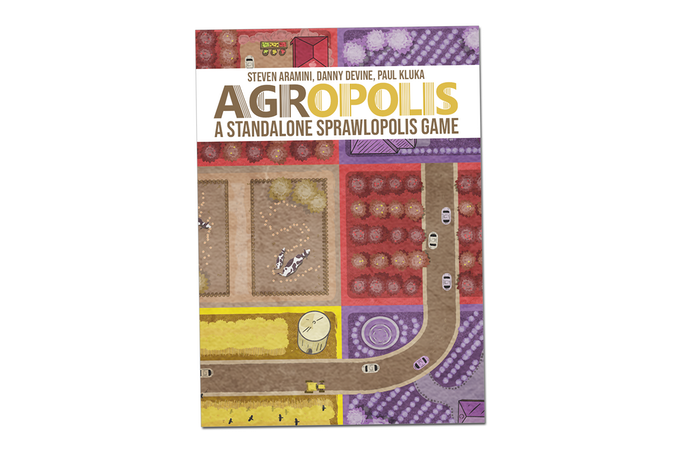
With the success of Sprawlopolis, Button Shy was keen to follow it up – which led to the creation of Agropolis (centred around farming) and Naturopolis (nature reserves). The idea behind those was to use the core mechanics of Sprawlopolis but add different scoring mechanics to fit the theme.
“We wanted to make sure these didn’t feel like a cash grab,” added Steven. “We all agreed that we would only keep doing them if we were able to make games that felt cool and unique, while still having some of that connective tissue between them. The first three were a trilogy but Casinopolis is something totally standalone. That’s really exciting because we can introduce totally new mechanics to surprise the audience.
“A little like that original move from the pyramid concept to Sprawlopolis, that’s actually very freeing because, unlike the first three games, we don’t have to make sure they can all combine together. We’re really trying to shake up the design now, and we’re still coming up with new stuff.
“We’re already thinking about two new ideas that introduce some new concepts and give the series a fresh perspective. It’s an exciting time for fans of the Opolis games!”
Related Article: The Best Button Shy Games