
Dungeon Kart is as close to Mario Kart: the board game as you can get without actually shelling out big dough for the license – but what has our reviewer made of it?
Written by Charlie Theel
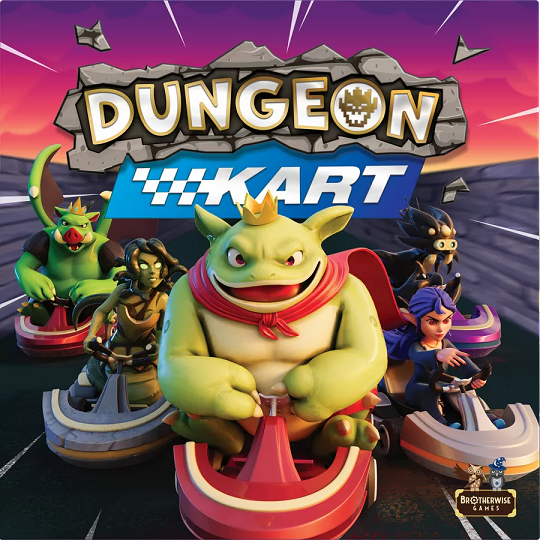
Mario Kart: but all of the characters are swapped out for the cast of Brotherwise Games’ Boss Monster, though the tone is spot on, and the gameplay contains all of the turmoil and zany racing the Nintendo property is known for.
In terms of complexity, this is on the fairly lighter end, boasting just a few more rules than peers such as Heat: Pedal to the Metal or Formula Dé. The increased rules density is a result of the clever action point system employed and the various manoeuvres it affords.
The goal is of course simple: complete one lap around the track before anyone else. On your turn, you will either increase or decrease the gear on your dashboard, moving the large shift knob to denote your setting. The gear corresponds to the movement points you must spend moving across the track, pivoting, and ramming into other hapless kart pilots.
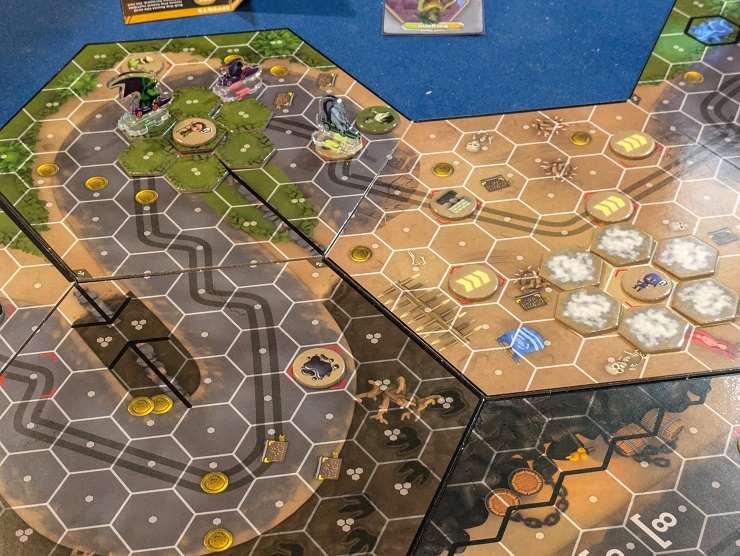
Movement is clever. Each space on the board contains one or more dots in the centre of the hex. This is how many movement points it costs to enter, with rough terrain eating up more of your speed budget. It does result in a somewhat cluttered visual space that isn’t overly attractive, but it’s effortless and requires no reference or memorisation of terrain types and how they modify the rules. In addition to moving straight and paying the hex cost, once per turn, you can turn by rotating one hex side, as well as move diagonally. Similarly, you can ram players you move through, but you may only collide with each player once during your movement. All of these straightforward limitations produce nuance and consideration that intermingle with the hazardous environment splendidly.
Take, for instance, turning. Since you can only turn one hex-side, you must prepare for tighter corners or tricky pathing in advance. This, of course, clashes with wanting to hit top speed, but more importantly, it often stands in opposition to the many obstacles scattered across the map. Most of these hazards are drawn randomly from a bag, meaning each track configuration will differ upon repeated plays. They consist of zombies (functionally banana peels), stone slabs, boosts, and more. The variety here is great, and the excellent player aid lists the effects of each hazard.
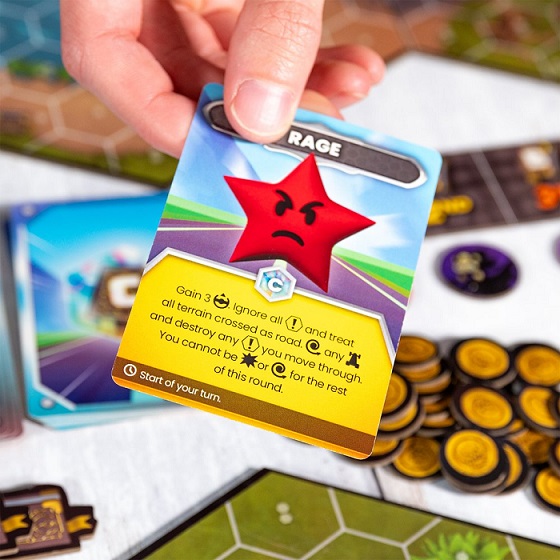
Of course, there are item boxes and coin spaces as well. These offer drawn abilities, with stronger cards being given to those farther behind. Some are exceptionally powerful, and the balance here can feel rough. It’s often a big disadvantage to be in the lead, particularly when everyone is jammed up and the placement is rather tight. This item catch-up element is lifted directly from Mario Kart, however, which certainly helps with acceptance.
The mixture of chaos and tactical thoughtfulness in Dungeon Kart is pretty effective. The main issue with this design is that it sits in a liminal space between the rip-roaring speedster Heat: Pedal to the Metal and the violent lawlessness that is Thunder Road Vendetta. It’s not quite as emotionally stirring as either, instead content to settle in as a pleasant family-appropriate escapade that expertly captures the feel of its influence. This is the game’s greatest achievement, for it’s difficult to imagine a more inspired or entertaining take on analogue Mario Kart.

Yes.
While not as strong as recent racing standouts, it’s still a very joyful racer with a colourful setting that hearkens to one of the best racing franchises of all time.
Try Dungeon Kart if you liked Thunder Road Vendetta. While sillier and more jovial, Dungeon Kart contains a lot of the same attitude and boisterousness of the reimagined Thunder Road.
Designer: Michael Xuereb
Publisher: Brotherwise Games
Time: 25-40 minutes
Players: 2-4
Ages: 8+
Price: £45